

Tax time shouldn’t feel like a surprise every year.
But for a lot of contractors, it does.
The work gets done. The invoices go out. Materials get purchased. Subs get paid. Jobs keep moving. Then tax season shows up, and suddenly everybody’s trying to figure out what happened over the last twelve months.
Receipts are missing. QuickBooks may not match the bank. Subcontractor payments may be scattered. Some expenses may be sitting uncategorized. And the tax professional is asking questions that should’ve been answered months ago.
That’s why tax-ready books for contractors matter.
Tax-ready books don’t mean everything is perfect. They mean your income, expenses, records, reports, and supporting documents are organized enough for a qualified tax professional to review without turning tax season into a cleanup project.
Contractor tax preparation starts with clean bookkeeping.

Tax Time Shouldn’t Start With a Mess
A messy tax season usually doesn’t happen all at once.
It builds slowly.
One receipt gets lost. A subcontractor payment doesn’t get recorded correctly. A bank account doesn’t get reconciled. A few transactions sit in QuickBooks waiting to be categorized. A customer payment gets matched to the wrong invoice. A material purchase gets buried in the wrong expense account.
Then, by the time tax season comes around, the books don’t tell a clear story.
That creates stress for the contractor and extra work for the person preparing the return.
It can also make it harder to have a useful tax planning conversation because the numbers aren’t clear yet.
Tax strategy works better when the books are clean before the deadline is close.
What Tax-Ready Books Actually Mean
Tax-ready books are organized, current, and clear enough to support tax filing and tax planning.
That doesn’t mean the contractor has to understand every accounting detail.
It means the financial records should answer basic questions like:
Is all business income recorded?
Are expenses categorized correctly?
Are bank and credit card accounts reconciled?
Are subcontractor payments organized?
Are W-9s collected where needed?
Are receipts and records available?
Are owner draws or distributions recorded clearly?
Can the tax professional review clean reports?
If the answer to several of those questions is “not sure,” the books may need cleanup before tax season.
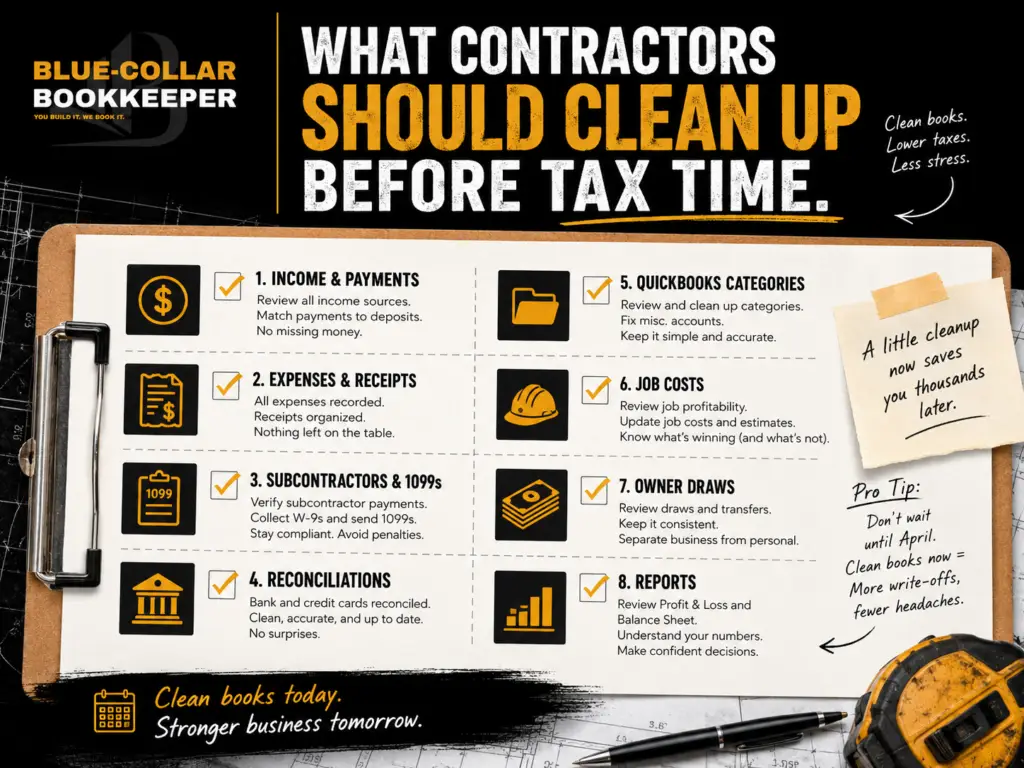
What Contractors Should Clean Up Before Tax Time
Contractors have more moving parts than many other small businesses.
You’re not just tracking sales and expenses. You may be dealing with deposits, progress payments, final invoices, job materials, labor, subcontractors, equipment rentals, fuel, tools, permits, insurance, and project costs.
Here are the main areas to clean up before tax time.
1. Income and Customer Payments
The first step is making sure business income is recorded correctly.
That includes customer payments, deposits, progress payments, final payments, retainers, and any other money received through the business.
For contractors, income can get messy when payments come in at different stages of a project. One customer may pay a deposit before work starts. Another may pay in draws. Another may pay after the job is complete.
If those payments aren’t recorded clearly, the income reports may not match reality.
Before tax time, review:
Customer payments
Open invoices
Deposits
Progress payments
Final payments
Refunds or credits
Payments received by cash, check, card, ACH, or apps
The goal is simple: your books should show what the business actually brought in during the year.

2. Expenses and Receipts
Contractor expenses can pile up fast.
Materials, tools, fuel, equipment rentals, repairs, insurance, software, office supplies, permits, licenses, and jobsite costs can all hit the books throughout the year.
The problem isn’t just that expenses happen. The problem is when they’re not categorized clearly or supported with records.
If too many expenses are missing, duplicated, or sitting in the wrong category, the reports become harder to trust.
Before tax time, contractors should review:
Material purchases
Tools and small equipment
Fuel and vehicle-related expenses
Equipment rentals
Repairs and maintenance
Insurance
Permits and licenses
Software and subscriptions
Office and admin expenses
Receipts and supporting documents
A shoebox full of receipts is not a bookkeeping system.
Receipts should be saved, organized, and matched where possible so the tax professional has better records to work with.
3. Subcontractor Payments and W-9s
Subcontractor tracking is a big tax-time issue for contractors.
If subcontractor payments aren’t organized throughout the year, January can get stressful quickly.
Before tax time, contractors should review who they paid, how much they paid, and whether they have the right vendor information on file.
That usually means reviewing:
Subcontractor names
Business names
Payment totals
Payment methods
W-9 records
1099 eligibility
Missing vendor information
Payments that may have been miscategorized
Subcontractor payments shouldn’t be mixed in with employee payroll or random general expenses.
They need to be clear enough for 1099 review and tax preparation.

4. 1099 Records
1099 prep isn’t something you should leave until the last second.
If subcontractor information is missing, it can take time to track people down. And if payments weren’t recorded correctly, the year-end totals may not be accurate.
Contractors should make sure W-9s are collected from subcontractors where needed and that payment records are separated by vendor.
This is especially important if payments were made by check, ACH, cash, or other direct methods.
Good 1099 records start with clean bookkeeping.
They don’t start with guessing in January.
5. Bank and Credit Card Reconciliations
Reconciliation is one of the most important parts of tax-ready bookkeeping.
It means comparing the books to actual bank and credit card statements to make sure the records line up.
If the accounts haven’t been reconciled, you may not know whether transactions are missing, duplicated, or recorded incorrectly.
For contractors, this matters because business activity moves fast. Customer payments, supplier charges, fuel purchases, subcontractor payments, equipment rentals, and owner draws can all run through the accounts.
Before tax time, make sure:
Bank accounts are reconciled
Credit card accounts are reconciled
Loan accounts are reviewed
Transfers are recorded correctly
Duplicate transactions are checked
Missing transactions are investigated
Old uncleared items are reviewed
If QuickBooks doesn’t match the bank, the books aren’t ready yet.
6. QuickBooks Categories
QuickBooks can be helpful, but only if the information inside it is clean.
If transactions are sitting in Uncategorized Expense, Ask My Accountant, or other holding accounts, the reports aren’t giving the full picture.
Before tax time, review whether transactions are categorized correctly.
For example:
Material purchases shouldn’t be randomly split between supplies, tools, and general expenses without a clear reason.
Subcontractor payments shouldn’t be buried in miscellaneous expenses.
Owner draws shouldn’t be treated like regular business expenses.
Loan payments may need to be split properly between principal and interest.
Transfers shouldn’t be counted as income or expenses.
This is where QuickBooks cleanup for contractors can become important.
If the file is messy, QuickBooks cleanup before tax time may need to happen so that the tax professional can trust the reports.
7. Job Costs and Project Records
Tax-ready books aren’t only about filing taxes.
They’re also an opportunity to understand how the business performed.
For contractors, that means reviewing job costs and project profitability.
A business may look busy on paper, but not every project produces strong profit. Materials may run high. Labor may take longer than expected. Subcontractor costs may increase. Change orders may not get billed correctly.
Before tax time, contractors should review:
Materials by job
Labor costs
Subcontractor costs
Equipment rentals
Permits and job-specific fees
Change orders
Customer payments
Completed project profitability
This helps the owner see more than total income and total expenses.
It helps show which jobs actually made money.

8. Owner Draws and Business/Personal Separation
Business and personal activity should be kept separate.
That sounds simple, but it gets messy fast when owners use business accounts for personal expenses or personal accounts for business purchases.
Before tax time, contractors should review:
Owner draws
Owner contributions
Personal expenses paid from the business
Business expenses paid personally
Transfers between accounts
Reimbursements
Business credit card activity
The goal is to make sure the books clearly show what belongs to the business and what doesn’t.
This is especially important when business and personal tax planning are connected.
9. Reports Your Tax Professional May Need
Clean reports make tax season easier.
Before tax time, contractors should be able to provide basic financial reports that make sense.
These may include:
Profit and Loss report
Balance Sheet
Accounts Receivable report
Accounts Payable report
Bank reconciliation reports
General ledger, if requested
Vendor payment reports
Job profitability reports, if available
Year-to-date income and expense summary
The reports don’t need to be fancy.
They need to be accurate, organized, and clear enough for review.
If the reports show strange balances, negative numbers that don’t make sense, old unpaid invoices, duplicate transactions, or huge uncategorized amounts, the books probably need cleanup first.
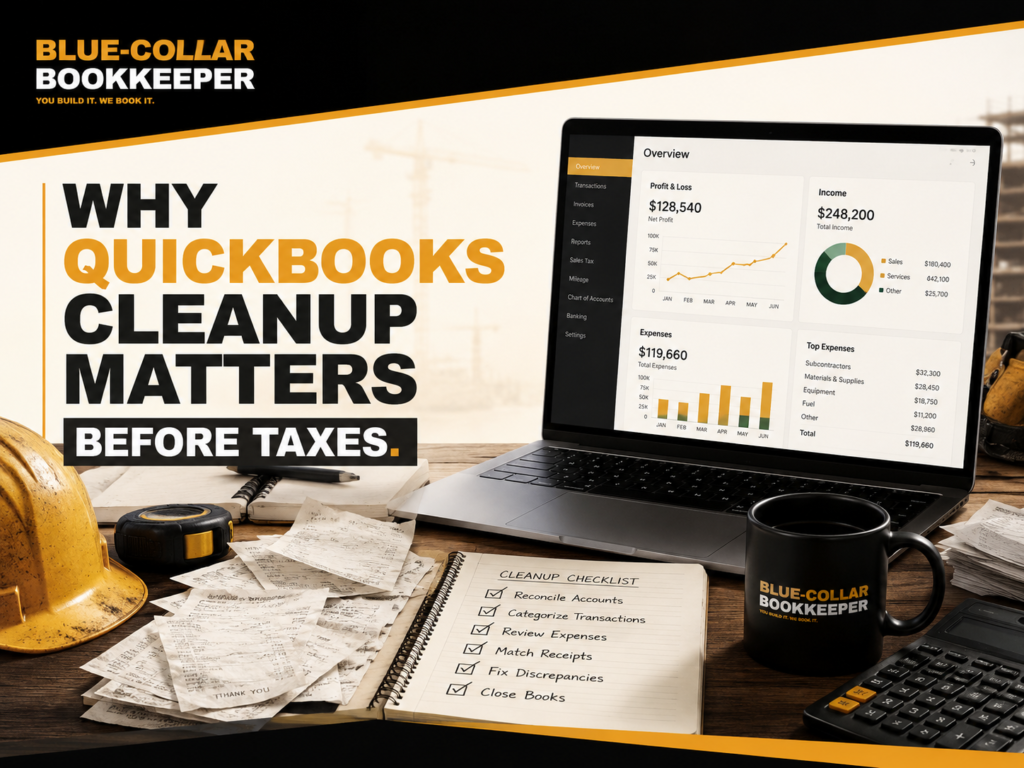
Why QuickBooks Cleanup Matters Before Taxes
QuickBooks cleanup matters because your tax professional is working from the records provided.
If the QuickBooks file is messy, the reports may not show the real financial picture.
For example, the business may have:
Duplicate income
Duplicate expenses
Uncategorized transactions
Incorrect vendor records
Old open invoices
Old unpaid bills
Unreconciled accounts
Misclassified owner draws
Job costs tied to the wrong projects
That kind of mess can slow everything down.
It can also make it harder to have a real tax planning conversation because the first step becomes figuring out whether the books are even right.
Cleanup gives the tax professional better information to work with.

Cleanup Bookkeeping May Need to Happen First
Sometimes the issue is bigger than QuickBooks.
The books may be months behind. Receipts may be missing. Bank statements may need to be reviewed. Transactions may need to be categorized. Reports may need to be rebuilt.
That’s where cleanup and catch-up bookkeeping comes in.
Cleanup and catch-up bookkeeping helps get the books current and organized before the business moves into monthly bookkeeping or tax planning.
For contractors, this can include reviewing old transactions, reconciling accounts, organizing income and expenses, cleaning up subcontractor records, and getting reports ready.

Monthly Bookkeeping Makes Next Tax Season Easier
The best time to prepare for tax season isn’t tax season.
It’s every month before that.
Monthly bookkeeping helps keep the books current so the business isn’t trying to clean up a full year all at once.
With monthly bookkeeping, contractors can keep transactions categorized, accounts reconciled, reports updated, and records easier to review.
That means fewer surprises when tax season comes around.
It also gives the owner better visibility throughout the year, not just when it’s time to file.

Tax Strategy Works Better With Clean Books
Tax planning, strategy, and filing support work better when the books are organized.
If the numbers are unclear, the tax conversation starts with cleanup.
If the books are current, the conversation can move toward planning.
That’s why bookkeeping and tax support should work together.
The Blue-Collar Bookkeeper helps contractors keep the books organized, and tax planning, strategy, and filing support may be coordinated through a trusted tax partner.
Clean books give the tax partner better information to review.
That can make the entire process smoother before tax time turns into a deadline.
Download the Contractor Tax-Ready Checklist
Not sure whether your books are ready?
Download the Contractor Tax-Ready Checklist and review the key areas contractors should organize before tax season.
The checklist walks through income, expenses, subcontractors, W-9s, QuickBooks cleanup, job costs, reports, and year-end planning questions.
Bookkeeping Built for Contractors
Contractors shouldn’t have to guess their way through tax season.
If the books are messy, behind, or hard to trust, it is better to deal with that before the deadline is close.
The Blue-Collar Bookkeeper helps contractors clean up their books, stay organized month to month, and get clearer numbers before tax time.
You build it. We book it.
Tax-Ready Books for Contractors FAQs
What are tax-ready books for contractors?
Tax-ready books are financial records that are organized, current, and clear enough for a qualified tax professional to review. For contractors, that may include income, expenses, receipts, subcontractor payments, W-9s, reconciliations, QuickBooks reports, and job cost records.
When should contractors clean up their books before tax time?
Contractors should not wait until the filing deadline is close. Ideally, books should be reviewed throughout the year. If the books are behind, cleanup should start as soon as possible so there is time to organize records before tax season.
Do contractors need QuickBooks cleanup before filing taxes?
Some contractors do. If QuickBooks has uncategorized transactions, duplicate entries, unreconciled accounts, old open invoices, or reports that do not match reality, cleanup may be needed before the tax professional can rely on the reports.
What records should contractors organize for 1099s?
Contractors should review subcontractor names, business information, W-9s, payment totals, payment methods, and vendor records. Subcontractor payments should be organized clearly before 1099 review begins.
Can clean books help with tax planning?
Yes. Clean books give the tax professional better information to review. Tax planning and strategy are harder when income, expenses, subcontractor records, owner draws, and reports are unclear.
Is tax-ready bookkeeping the same as tax preparation?
No. Tax-ready bookkeeping helps organize the financial records before tax preparation. Tax preparation and filing should be handled by a qualified tax professional.

Ready to Get Your Books Tax-Ready?
Tax season should not start with messy books and unanswered questions.
If your books are behind, disorganized, or hard to trust, The Blue-Collar Bookkeeper can help you get a clearer look at where things stand.
You build it. We book it.