

If opening QuickBooks makes you want to close the laptop, your books are probably trying to tell you something.
Most contractors don’t set out to let the books get messy. It usually happens slowly.
A receipt gets tossed in the truck. A supplier invoice gets paid but never entered right. A customer sends a deposit, but it doesn’t get tied to the right job. A credit card charge gets categorized as “materials” even though nobody remembers which project it belonged to. A subcontractor gets paid, but the 1099 information isn’t organized.
At first, it doesn’t feel like a big deal.
You’re busy. Jobs are moving. Crews need answers. Customers need updates. Materials need to be ordered. There’s always something more urgent than bookkeeping.
But eventually, the books catch up with you.
Tax time gets stressful. Reports stop making sense. You’re not sure which jobs made money. The bank account feels tighter than it should. QuickBooks says one thing, real life says another, and you’re left wondering where the money went.
That’s where contractor bookkeeping cleanup comes in.
Bookkeeping cleanup isn’t about making your books look pretty. It’s about getting your numbers back to a place where you can trust them.
Because if your books are behind, you’re not just dealing with an accounting problem.
You’re trying to run a contracting business with a foggy windshield.

Being Busy Can Hide Messy Books
Messy books for contractors can keep you looking successful from the outside.
The calendar is full. The crew is working. Invoices are going out. Customers are paying. The business is bringing in revenue.
But behind the scenes, the numbers may not be telling the truth.
That’s one of the hard parts about running a trade business. Activity can hide problems.
A busy month can cover up weak job margins. A big deposit can make cash flow look better than it really is. A few late supplier bills can make a job look profitable until the actual costs land. A full schedule can distract you from the fact that nobody has reconciled the accounts in months.
Busy doesn’t always mean healthy.
Clean books help you see the difference.
Signs Your Contractor Books Are Behind
Most contractors don’t fall behind on their books because they are lazy.
They fall behind because they’re busy.
Jobs are moving. Materials need to be ordered. Crews need direction. Customers need updates. Invoices need to go out. Problems on the jobsite need to be handled now, not later.
So the books get pushed to the side.
At first, it may not seem like a big deal. A few receipts are missing. A few transactions are uncategorized. QuickBooks hasn’t been reviewed in a while. Maybe the bank balance looks close enough.
But eventually, messy books start showing up in bigger ways.
You may not know which jobs actually made money. You may feel short on cash even after a strong month. You may avoid looking at reports because you aren’t sure they’re right. Tax time may feel like a scramble instead of a normal part of doing business.
That’s usually when bookkeeping cleanup becomes more than a nice idea.
It becomes necessary.
Here are the signs your contractor books may be behind and need a closer look.
Sign #1: Your Bank Balance Doesn’t Match QuickBooks
This is one of the clearest signs your books need cleanup.
If your bank account says one number and QuickBooks says something different, your books may not be reconciled properly.
That can happen for a lot of reasons.
Transactions may be missing. Payments may be duplicated. Checks may not be cleared. Credit card charges may not be matched correctly. Transfers may be recorded as income by mistake. Old transactions may still be sitting there waiting for review.
For a contractor, this matters because your bank balance is already only part of the story.
You still have bills coming due, payroll to cover, materials to order, taxes to set aside, and customer payments that may or may not have cleared.
If QuickBooks doesn’t match the bank, it becomes even harder to know what money is actually available.
You don’t need perfect reports that look fancy.
You need numbers that line up with reality.
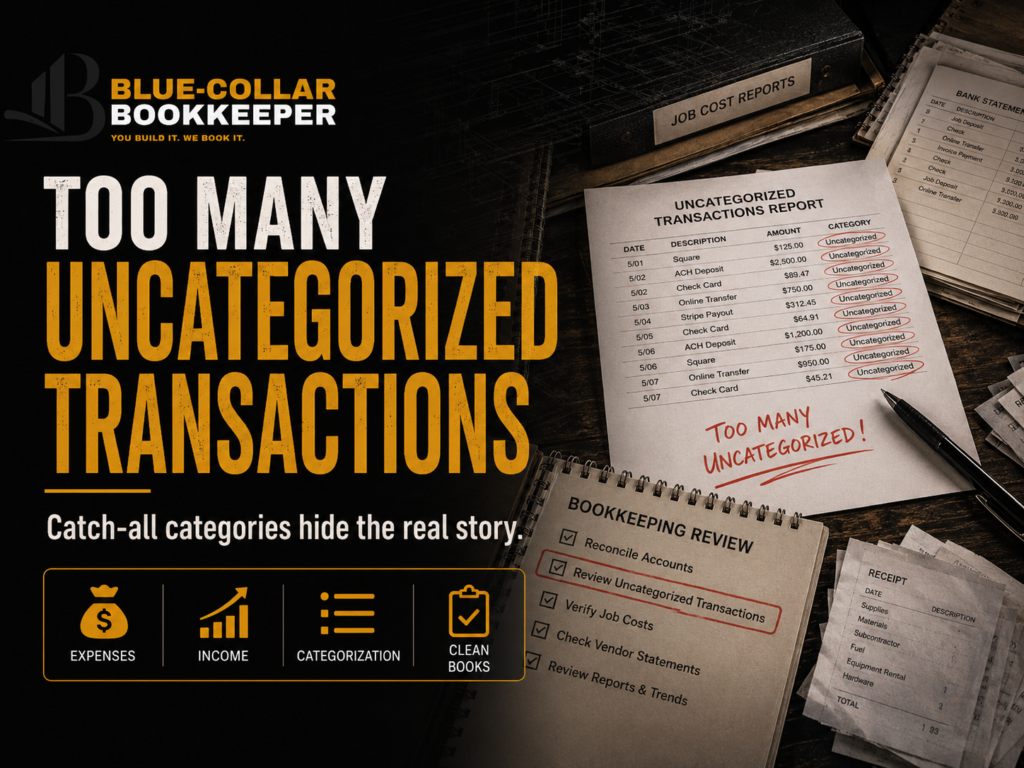
Sign #2: You Have Too Many Uncategorized Transactions
A few uncategorized transactions happen.
A long list of them is a problem.
If your QuickBooks file has a pile of transactions sitting in “Uncategorized Expense,” “Uncategorized Income,” “Ask My Accountant,” or random catch-all categories, your reports are probably not giving you a clear picture.
This is especially important for contractors because expenses need context.
A $1,200 supply purchase could be materials for a specific job. It could be tools. It could be repairs. It could be overhead. If it gets dumped into the wrong place, your job numbers and profit reports can get distorted fast.
The same is true for deposits.
A payment from a customer needs to be connected properly so you can tell what was paid, what’s still owed, and whether the job is actually profitable.
When too many transactions are uncategorized, your books aren’t really cleaned up.
They’re just parked.
Sign #3: You Don’t Know Which Jobs Made Money
This is a big one.
If you can look back at your last few jobs and say which ones were profitable, which ones were tight, and which ones cost more than expected, you’re in a much better position as an owner.
But if every job gets blended together, you’re guessing.
A contractor can complete a $40,000 job and still not know if it was worth doing.
Materials may have run high. Labor may have gone over. A subcontractor may have billed more than expected. A change order may not have been collected. The final payment may still be sitting unpaid.
Without clean books, the job may look fine because revenue came in.
But revenue isn’t profit.
Bookkeeping cleanup helps separate the noise. It helps you see whether job costs are being tracked clearly and whether your reports are useful enough to guide decisions.
Because if you don’t know which jobs make money, it’s hard to know which jobs to chase next.
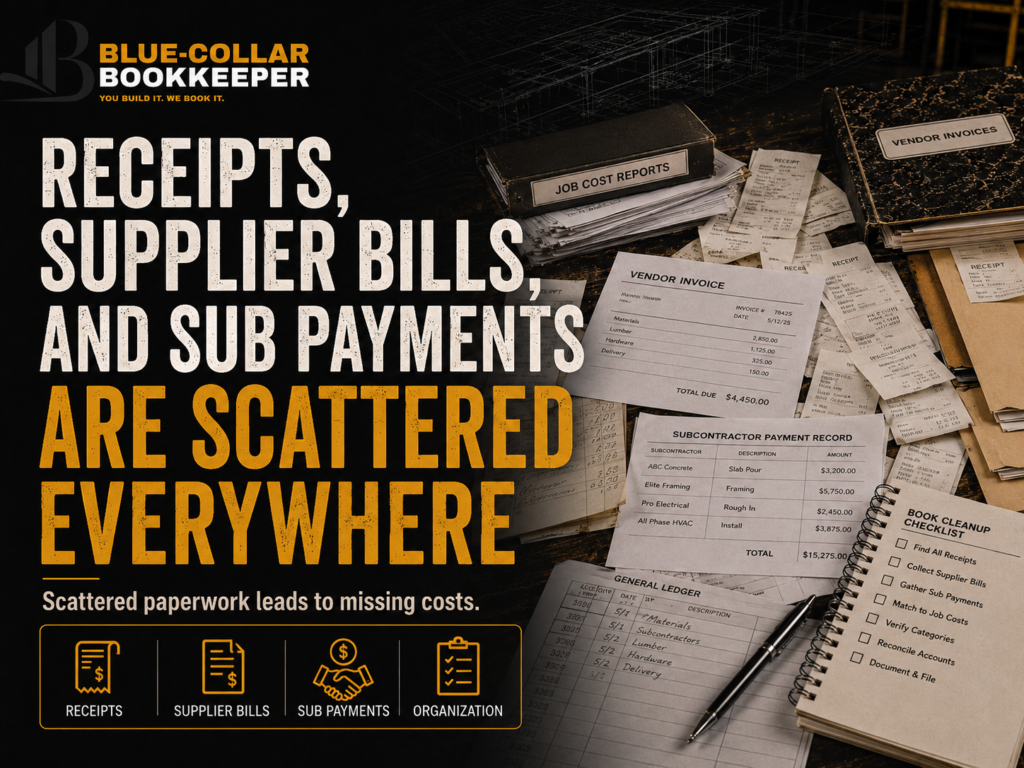
Sign #4: Receipts, Supplier Bills, and Sub Payments Are Scattered Everywhere
Contractor paperwork can get messy fast.
Receipts in the truck. Supplier statements in email. Subcontractor invoices by text message. Fuel charges on the card. Materials paid from one account. Tools bought from another. Customer checks deposited at different times.
That’s real life in the trades.
But if those records are scattered everywhere, your books are going to suffer.
You may not have the backup you need for expenses. You may miss costs that should be tied to jobs. You may have trouble tracking who was paid and when. You may not be ready for 1099s. You may find yourself trying to remember what happened months after the job’s done.
That’s a bad position to be in.
Cleanup brings those pieces back together.
The goal isn’t to make you a paperwork person. The goal is to build a system where the important numbers do not disappear.

Sign #5: Tax Time Turns Into a Scramble
Tax season shouldn’t feel like an emergency every year.
If it does, your books may need cleanup.
A lot of contractors wait until the last minute and then try to pull everything together at once. Receipts. Bank statements. Credit cards. Subcontractor payments. Equipment purchases. Loan payments. Owner draws. Customer income. Mileage or vehicle expenses.
That’s a lot to untangle under pressure.
When the books are behind, tax time gets more stressful than it needs to be. Your tax preparer may ask questions you cannot answer quickly. Reports may not be reliable. Expenses may need to be reworked. Income may need to be reviewed. Accounts may need to be reconciled before anything else can move forward.
Bookkeeping cleanup helps get the records back in order so tax season isn’t a guessing game.
Your bookkeeper doesn’t replace your CPA or tax preparer.
But clean books can make that process a whole lot smoother.
Sign #6: Your Reports Don’t Match Reality
This is one of the most frustrating signs.
You run a profit and loss report, and it says the business is doing fine.
But the bank account says otherwise.
You brought in good revenue, but you feel tight on cash. You have jobs on the books, but you’re not sure where the money is going. You think you made a profit, but there isn’t much left after payroll, materials, bills, and taxes.
When reports don’t match reality, it usually means something in the books needs attention.
Maybe expenses are missing. Maybe income is duplicated. Maybe job costs are not being separated from overhead. Maybe payments aren’t being matched correctly. Maybe old transactions are still unreconciled.
Whatever the reason, the result is the same.
You stop trusting the reports.
And once you stop trusting the reports, you stop using them.
That’s when tax-ready books for contractors becomes a tax-time chore instead of a business tool.
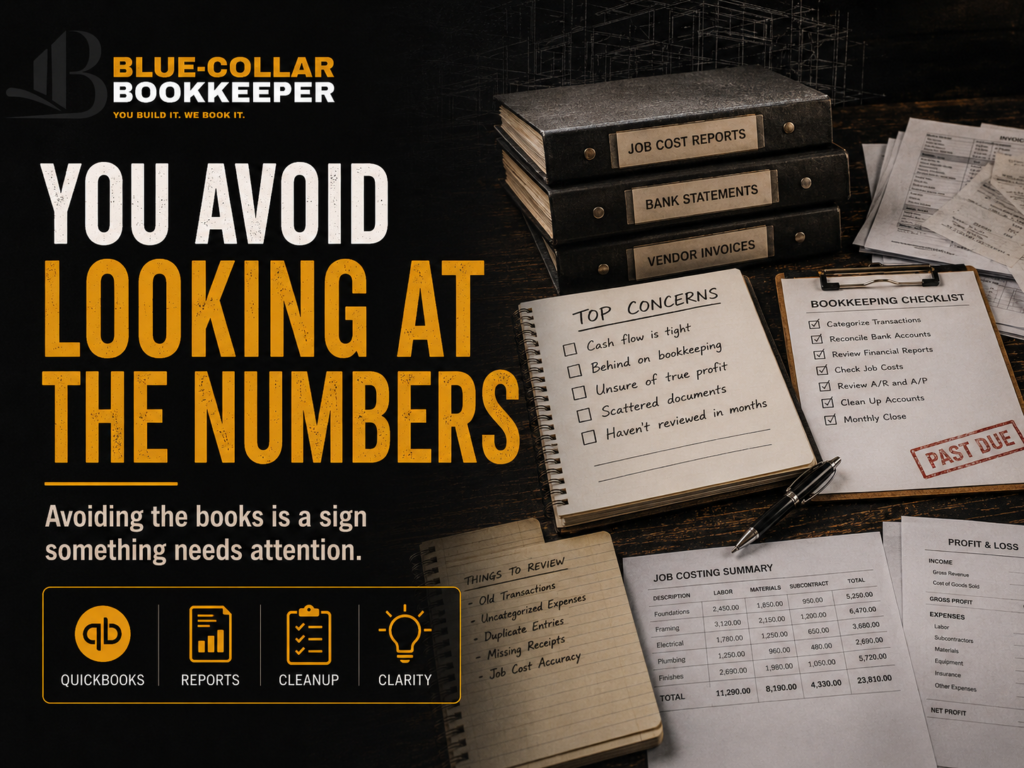
Sign #7: You Avoid Looking at the Numbers
This one doesn’t show up on a report, but it matters.
If you avoid looking at your books because you already know they are messy, that’s a sign.
If you feel a knot in your stomach when you think about QuickBooks, that’s a sign.
If you keep telling yourself you will deal with it after the next job, after the next payment, after the next busy season, that’s a sign.
A lot of contractors know something is off before they can explain it.
They feel it.
They know the business is moving, but the numbers don’t feel clear. They know tax time is coming. They know there are old transactions that need attention. They know the reports probably aren’t right.
Avoiding the books doesn’t make you a bad business owner.
It means the system isn’t working for you right now.
And that can be fixed.

A Real-World Example
Let’s say a general contractor has been busy for the last six months.
He has completed several remodels, brought in solid revenue, and kept the crew moving. From the outside, things look good.
But when he finally sits down to look at the books, there are problems everywhere.
There are 147 uncategorized transactions. Two bank accounts have not been reconciled in months. Supplier bills are missing from a few jobs. Several customer deposits were recorded as general income but never tied back to the right projects. Subcontractor payments are spread across checks, ACH payments, and credit card charges. A few personal expenses are mixed into the business account.
The profit and loss report says the business made money.
But the owner doesn’t believe it.
And he’s right to question it.
After cleanup, the picture changes.
One job that looked profitable was barely above break-even because materials were higher than expected. Another job had a strong margin, but the final payment was still outstanding. Several expenses had been sitting in the wrong categories. A few duplicate entries were throwing off the numbers.
The business wasn’t failing.
The books were just too messy to tell the truth.
That’s what cleanup is for.
It takes the pile of unclear numbers and turns it into something the owner can actually use.
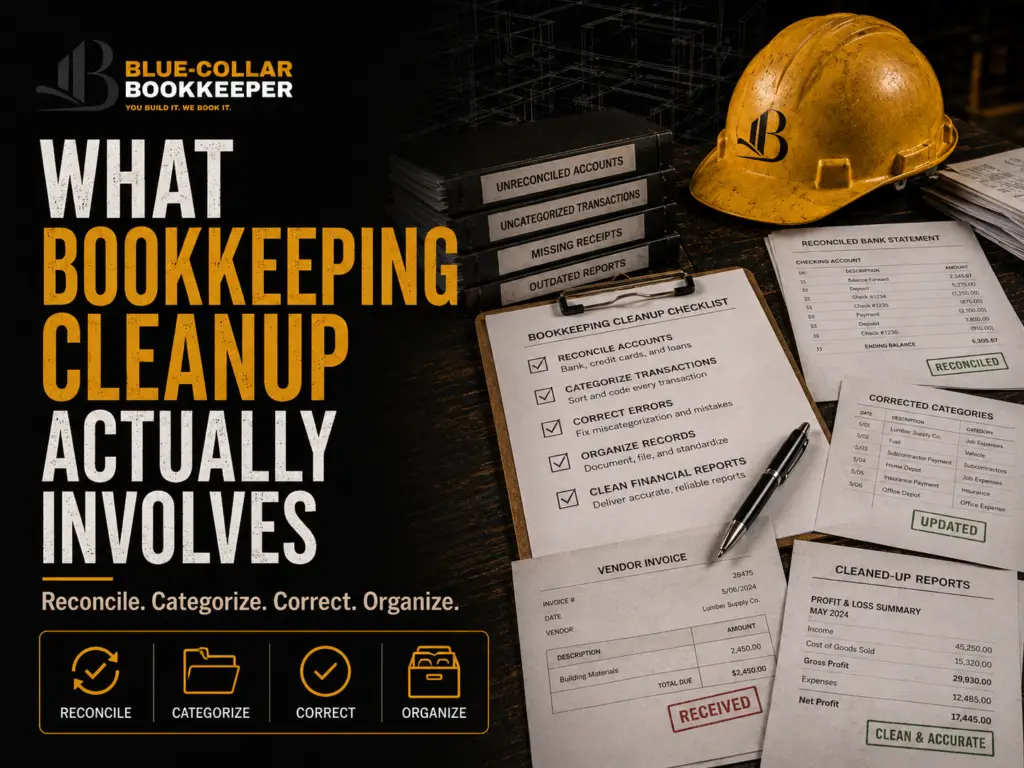
What Contractor Bookkeeping Cleanup Actually Involves
Bookkeeping cleanup is the process of getting your financial records corrected, organized, and current.
For contractors, that usually means more than just categorizing a few transactions.
A proper cleanup may include:
- Reviewing bank and credit card accounts
- Reconciling accounts against statements
- Categorizing income and expenses correctly
- Cleaning up duplicate transactions
- Reviewing old unpaid invoices
- Reviewing unpaid bills
- Separating job costs from overhead where possible
- Organizing subcontractor payments
- Reviewing owner draws and personal expenses
- Correcting miscategorized transactions
- Checking loan and equipment payment entries
- Preparing cleaner reports
- Identifying areas that need better monthly tracking
The goal isn’t just to “catch up.”
The goal is to make the books useful again.
Because once your books are cleaned up, you should be able to look at your reports and have a better sense of what’s actually happening in the business.

Cleanup First, Monthly Bookkeeping Second
A lot of contractors want monthly bookkeeping, but their books need cleanup first.
That’s normal.
If the foundation is messy, monthly bookkeeping has nothing solid to build on.
Cleanup gets the books back in order. Monthly bookkeeping helps keep them that way.
Think of it like a jobsite.
You wouldn’t frame walls on a bad foundation and expect the house to come out right.
Your books work the same way.
If old transactions are wrong, accounts aren’t reconciled, and reports cannot be trusted, the monthly work needs to start by fixing the foundation.
Once that’s done, ongoing bookkeeping becomes much more valuable.
You can keep transactions current. Reconcile accounts regularly. Review reports monthly. Track job costs more clearly. Stay closer to tax-ready throughout the year.
That’s when bookkeeping starts helping you run the business, not just clean up after it.

When to Get Help
You don’t need to wait until everything is on fire.
In fact, it’s usually better not to.
You should consider getting cleanup bookkeeping for contractors help if:
- You’re more than a couple months behind
- You’re not confident your reports are accurate
- You have a lot of uncategorized transactions
- Your bank accounts are not reconciled
- Your books are messy before tax time
- You don’t know which jobs made money
- You’re applying for financing or need cleaner records
- You’re trying to grow but you don’t trust the numbers
- You want monthly bookkeeping, but you need the books cleaned up first
The longer messy books sit, the harder they can be to untangle.
But the good news is simple.
QuickBooks cleanup for contractors can be achieved.
You don’t have to keep guessing; contact Blue-Collar Bookkeeper.
We’ll take a look at where your books stand, what may be unclear, and what it would take to get your numbers working for you instead of against you.
Start with a free financial consultation.
You build it. We book it.
Contractor Bookkeeping Cleanup FAQs
How do I know if my contractor books need cleanup?
Your books may need cleanup if your bank balances don’t match QuickBooks, you have many uncategorized transactions, your reports don’t make sense, accounts aren’t reconciled, or tax time turns into a scramble.
For contractors, another major sign is not knowing which jobs actually made money.
What is the difference between cleanup bookkeeping for contractors and monthly bookkeeping?
Cleanup bookkeeping fixes books that are behind, messy, or inaccurate.
Monthly bookkeeping keeps your books current going forward.
Many contractors need cleanup first, then monthly bookkeeping afterward so the same problems don’t keep coming back.
Can messy books affect job profitability?
Yes.
If labor, materials, subcontractors, and other job costs aren’t tracked correctly, you may not know which jobs are actually profitable.
That can lead to underpricing work, chasing the wrong jobs, or thinking the business is doing better than it really is.
Do I need QuickBooks cleanup for contractors before monthly bookkeeping?
Sometimes, yes.
If your QuickBooks file has old errors, unreconciled accounts, duplicate transactions, or messy categories, cleanup may be needed before monthly bookkeeping can be done properly.
Starting monthly bookkeeping on top of bad numbers usually creates more confusion.
How far back should contractor books be cleaned up?
It depends on the condition of the books and what you need them for.
Some contractors only need the current year cleaned up. Others may need prior years reviewed, especially if accounts were never reconciled or if old transactions are still affecting current reports.
A bookkeeping review can help determine how far back the cleanup should go.
Will bookkeeping cleanup help at tax time?
Yes, clean books can make tax time much smoother.
Cleanup helps organize income, expenses, subcontractor payments, loan payments, owner draws, and reports so your tax preparer has cleaner information to work with.
Your bookkeeper doesn’t replace your tax professional, but clean books can reduce the stress and confusion around tax season.
Can cleanup help with cash flow?
Yes.
When your books are cleaned up, you can get a clearer picture of unpaid invoices, upcoming bills, supplier costs, payroll pressure, and what money is actually available.
That makes it easier to understand why cash feels tight and what needs attention.
What should I do if I am embarrassed about how messy my books are?
Don’t let that stop you from getting help.
Most messy books happen because the business got busy, and the bookkeeping system did not keep up. That’s common in the trades.
The important thing is getting the numbers back under control so you can move forward with more confidence.