
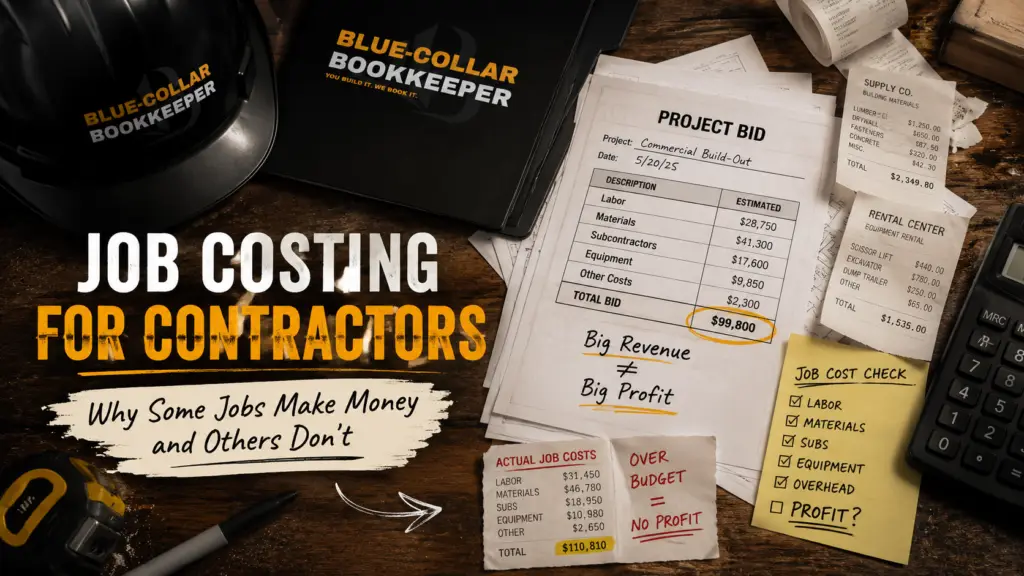
A $40,000 job can feel like a win until you find out it only left you with $2,000.
That’s the part a lot of contractors don’t see clearly enough.
The work looked good. The customer paid. The crew stayed busy. Materials were ordered. The work got done. From the outside, it seemed like a solid project.
But once you look at the real numbers, the story might be different.
Materials ran higher than expected. Labor took two extra days. A subcontractor had to be brought in. A change order never got billed. Fuel, equipment, dump fees, and supplies all added up.
By the time everything is counted, that “good job” may not have been nearly as profitable as it felt.
That’s why job costing for contractors matters.
For contractors, bookkeeping shouldn’t just show how much money came in and went out. It should show which jobs are actually making money, which ones are too tight, and which ones need better pricing, better tracking, or better planning next time.
At The Blue-Collar Bookkeeper, we believe contractors deserve numbers that make sense in the real world.
You build it. We book it.
And if you’re not tracking profit by job, you may be working harder than you need to for less than you think.
A Big Job Isn’t Always Profitable
Contractors are used to looking at big numbers.
A $25,000 job. A $40,000 job. A $90,000 month.
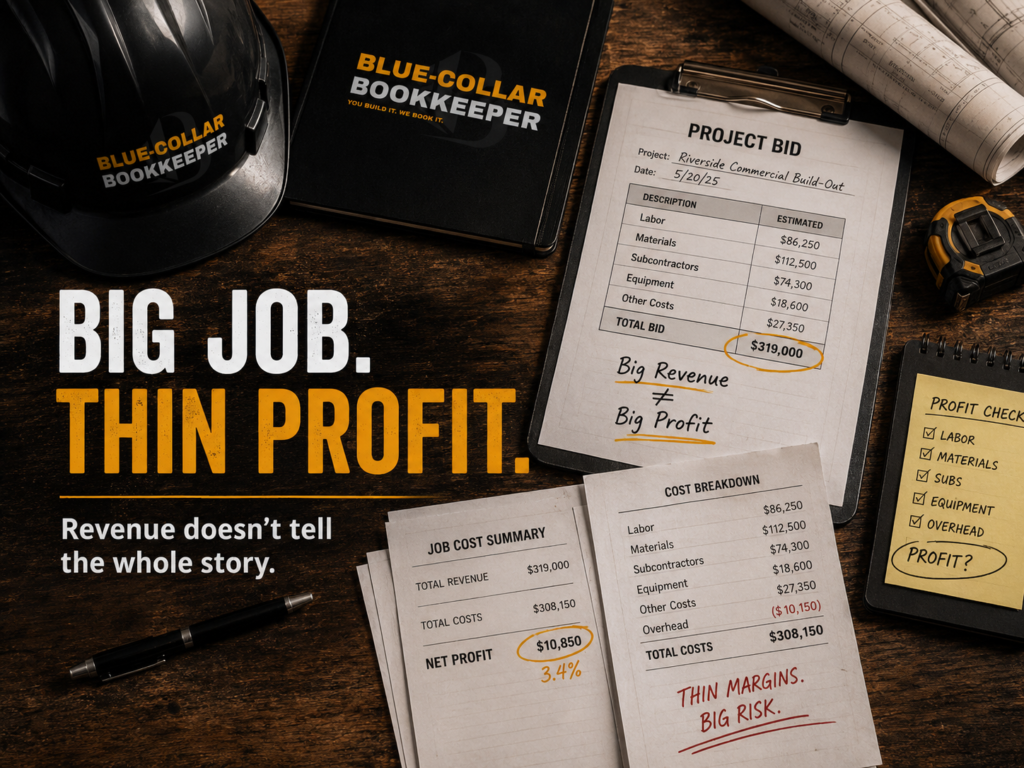
Those numbers can feel good, but revenue is only the top line.
Revenue doesn’t show what it cost to complete the work.
A big job can still be a weak job if the costs get out of hand. That’s where a lot of contractors get squeezed. The work brings in money, but by the time materials, labor, subcontractors, equipment, fuel, permits, callbacks, and overhead are considered, there may not be much left.
Sometimes the problem is pricing.
Sometimes the problem is tracking.
Sometimes the problem is that the contractor doesn’t see the full cost until weeks after the job is done.
That’s dangerous because if you don’t know which jobs are making money, you may keep chasing work that keeps you busy but doesn’t move the business forward.
Busy isn’t the goal.
Profitable is.
What Job Costing Actually Means
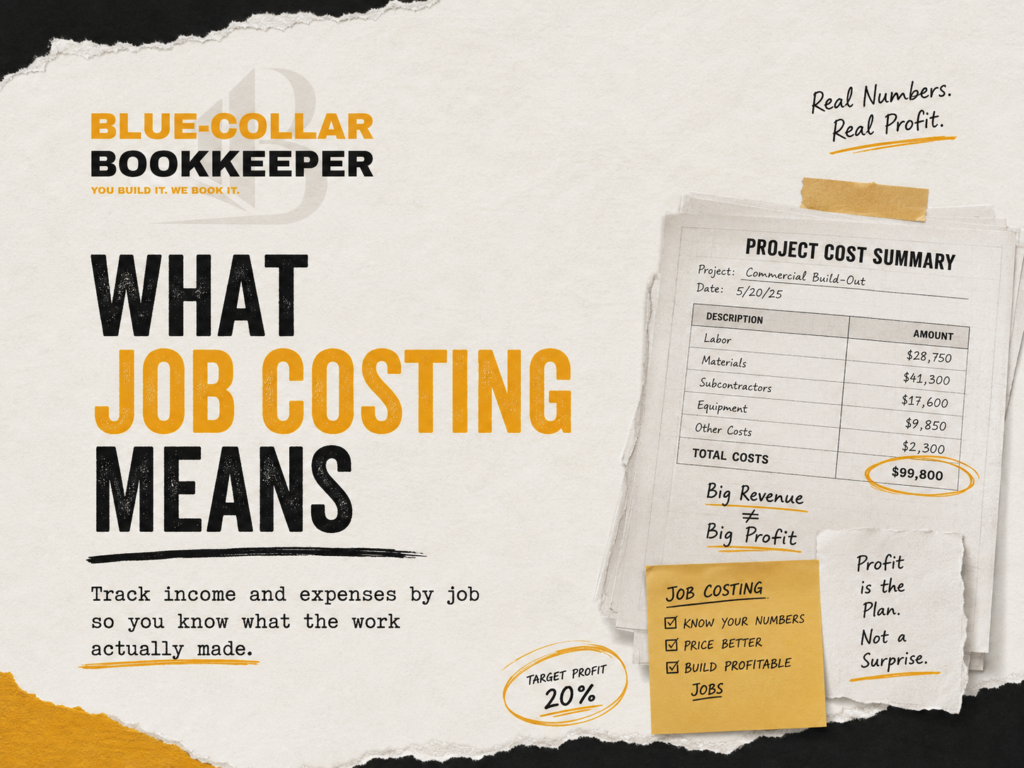
Job costing means tracking the income and expenses connected to a specific project.
That’s it.
It doesn’t need to sound complicated.
If you’re a contractor, job costing helps answer one basic question:
Did this job make money?
To answer that, you need to know what the customer paid and what the project actually cost.
That means tracking the direct costs tied to that project, not just dumping everything into broad categories at the end of the month.
For example, if you bought materials for the Smith roofing job, those materials should be tied to the Smith roofing job. If you paid a subcontractor for the Jones remodel, that payment should be tied to the Jones remodel. If your crew spent three days on one project instead of the two days you planned, that matters.
Regular bookkeeping for contractors tells you how the business performed overall.
Job costing helps you understand how each project performed.
Both matter.
But for contractors, job costing is often where the real story shows up.
How Contractors Track Job Costs on Every Job
You don’t need to track every tiny detail forever, but you do need a clear system for the major costs that affect profit.
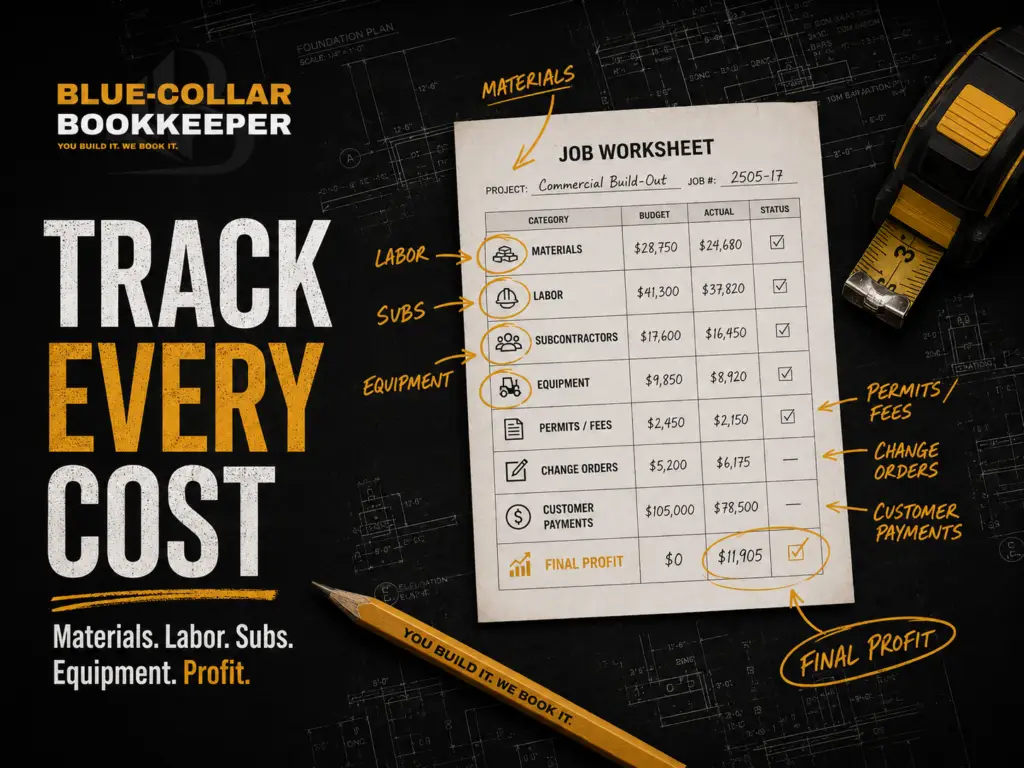
Here are the main items involved in how contractors track job costs.
Materials
Materials are one of the easiest places for profit to disappear.
Prices change. Extra supplies get picked up. A rushed order may cost more. Waste may be higher than expected. A missed measurement can turn into another trip to the supplier.
If materials aren’t tied to the right work order, you may not know whether a project stayed on budget.
Good job costing should help show:
- What materials were purchased
- Which build they belonged to
- Whether material costs were higher than estimated
- Whether supplier bills were entered correctly
- Whether extra purchases changed the final profit
A materials bill sitting in a generic expense category doesn’t tell you enough.
You need to know which work order it affected.
Labor
Labor can make or break a job.
A build that was supposed to take two days but took four days has a very different profit picture.
That doesn’t always mean the crew did something wrong. Weather, access issues, customer changes, bad measurements, waiting on materials, or jobsite surprises can all slow things down.
But if you’re not tracking labor by job, you may never see the pattern.
Maybe one type of project always takes longer than expected. Maybe certain work orders need a higher estimate. Maybe your crew is getting pulled into too many small fixes that never get billed.
Labor isn’t just a payroll number.
It’s one of the biggest pieces of job profitability.
Subcontractors
Subcontractor costs need to be tracked clearly.
A subcontractor payment shouldn’t just sit in a broad “contract labor” category with no job attached.
You need to know which project the sub worked on, how much was paid, whether the amount matched the estimate, and whether their invoice came in before or after the work order was reviewed.
Late sub invoices can make a job look profitable at first, then change the numbers later.
That’s why clean books for contractors matters.
Equipment and Rentals
Equipment rentals, tool rentals, lifts, dumpsters, trailers, and other job-specific equipment costs should be tracked when they belong to a project.
These costs can sneak up on contractors.
One rental extension may not seem like a big deal. A few extra days on equipment may feel manageable. But across multiple builds, those costs can eat into profit fast.
If equipment or rental costs are tied to the wrong place, you may not realize which work orders are carrying extra weight.
Permits and Fees
Permits, inspection fees, disposal fees, and other project-related costs should be included in the job cost picture.
These may not always be the biggest expenses, but they still affect margin.
If they’re missed, the customer project may look better than it really was.
Change Orders
Change orders are one of the biggest places contractors lose money.
The customer asks for something extra. The crew handles it. Materials get added. Labor takes longer. Everybody moves on.
But if the change order doesn’t get priced, approved, tracked, and billed, the contractor may be giving away work.
That’s not just a bookkeeping problem.
That’s a profit problem.
Good job costing helps make those extras visible so they don’t disappear into the project.
Customer Payments
You also need to track what the customer paid and what they still owe.
A job isn’t fully understood until you know:
- The original contract amount
- Deposits collected
- Progress payments received
- Change orders billed
- Final invoice amount
- Remaining balance
- Whether the customer paid in full
A project can look profitable on paper but still hurt cash flow if the final payment is late.
Final Job Profit
At the end of the job, you should be able to look back and understand the result.
Not just whether the customer was happy.
Not just whether the work got done.
You should know whether the build made money.
A simple job profitability view should show:
- Total revenue
- Materials
- Labor
- Subcontractors
- Equipment and rentals
- Permits and fees
- Other job costs
- Gross profit
- Profit margin
That’s how to track materials labor and subcontractors costs for the kind of information that helps you make better decisions next time.

A Real-World Contractor Example
Let’s say a contractor takes on a remodel job for $42,000.
At first, it looks like a strong project.
The customer pays a $14,000 deposit up front. The crew gets started. Materials are ordered. The schedule looks manageable.
The original estimate looked something like this:
- Materials: $11,500
- Labor: $12,000
- Subcontractors: $5,500
- Equipment and fees: $1,500
- Expected job costs: $30,500
- Expected gross profit: $11,500
That looks like a decent work order.
But then real life happens.
Materials come in higher than expected and land at $13,900. Labor takes two extra days and ends up at $15,800. A subcontractor invoice comes in at $6,700 instead of $5,500. There’s an extra dump fee and a small equipment rental extension, adding another $1,100.
Then the customer asks for a change that should’ve been billed at $2,400, but it gets handled in the field and never added to the final invoice.
Now the actual numbers look more like this:
- Revenue collected: $42,000
- Materials: $13,900
- Labor: $15,800
- Subcontractors: $6,700
- Equipment, dump fees, and permits: $2,600
- Total costs: $39,000
- Gross profit: $3,000
That project still brought in $42,000.
But it only left $3,000 before overhead, taxes, owner pay, and other business expenses.
That’s a very different story.
Without job costing, the contractor may only remember that it was a $42,000 build.
With job costing, he can see what actually happened and improve contractor profit margins.
Materials ran high. Labor took longer. Sub costs increased. A change order was missed. The job wasn’t priced or controlled tightly enough.
That’s not about beating yourself up.
It’s about learning from the numbers so the next project is better.

Why Job Costs Get Missed
Most contractors don’t miss job costs because they don’t care.
They miss them because the work moves fast.
Receipts end up in the truck. Supplier bills come in after the work is done. Subcontractors send invoices by text or email. Crew time is tracked loosely. Materials get picked up for multiple jobs at once. Change orders happen in conversation instead of on paper.
That’s normal in the trades.
But normal doesn’t mean harmless.
Job costs get missed when:
- Materials aren’t assigned to a specific job
- Labor hours aren’t tracked clearly
- Subcontractor payments aren’t connected to the right project
- Supplier bills are entered late
- Receipts are missing
- Change orders aren’t documented
- Expenses are dumped into broad categories
- Job costs and overhead are mixed together
- The books are only reviewed at tax time
When those things happen, your reports may still show numbers.
They just may not show the truth.
That’s when bookkeeping cleanup becomes a priority.
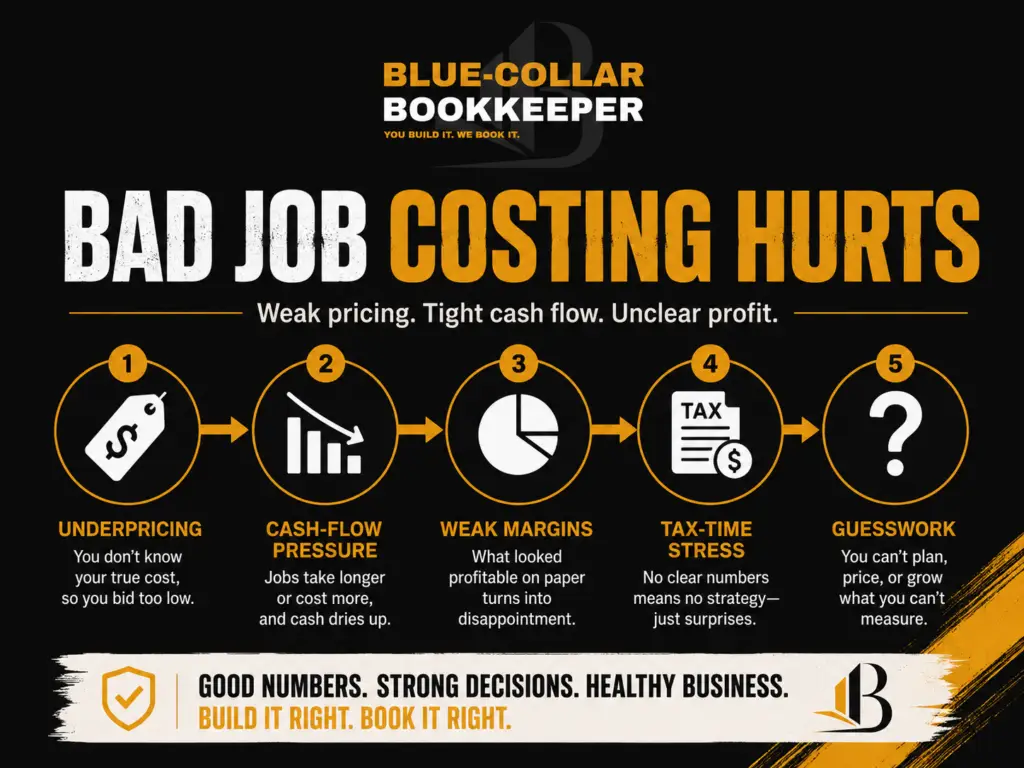
How Bad Job Costing Hurts the Business
Poor job costing creates problems that show up everywhere else.
It affects pricing.
If you don’t know what your customer projects actually cost, it’s hard to price the next one correctly. You may keep bidding too low without realizing it.
It affects cash flow.
If project costs are higher than expected or customer payments are late, the business can feel tight even when revenue looks strong.
It affects hiring and crew planning.
If labor is running over on certain types of jobs, you need to know that.
It affects tax-time records.
If expenses aren’t categorized or documented clearly, tax season can become more stressful than it needs to be.
It affects confidence.
When you don’t trust the numbers, every decision feels like a guess.
And contractors already deal with enough uncertainty.
Your books shouldn’t add more.
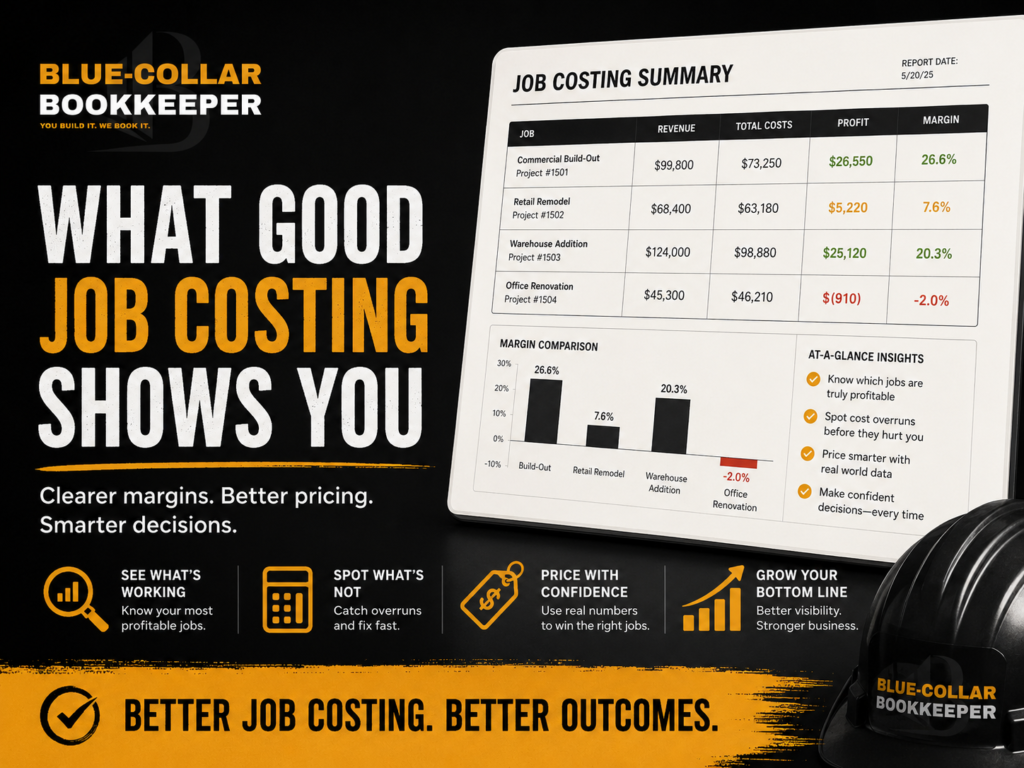
What Good Job Costing Should Show You
Good job costing should give you a clearer view of what’s working and what’s not.
It should help you answer questions like:
- Which build made the most profit?
- Which project had the tightest margins?
- Which type of work should we do more of?
- Which jobs are we underpricing?
- Are materials coming in higher than expected?
- Are labor hours being estimated correctly?
- Are subcontractor costs changing the margin?
- Are change orders being billed properly?
- Are late payments hurting cash flow?
This is where the numbers from job profitability reports become useful.
Not fancy.
Useful.
When job costing is done well, you can start making better decisions. You can price smarter. You can spot margin leaks. You can see which projects are worth repeating. You can avoid chasing work that keeps you busy but doesn’t leave enough profit.
That’s what contractors need from their books.

Job Costing Works Best With Clean Monthly Books
Job costing doesn’t work well if the books are already messy.
If transactions are uncategorized, accounts aren’t reconciled, receipts are missing, and reports don’t match reality, job costing will be harder to trust.
That’s why cleanup and monthly bookkeeping matter.
Bookkeeping cleanup gets the numbers back in order.
Monthly bookkeeping helps keep them current.
Job costing then gives you a better view of each project.
The three work together.
If you want to know whether your projects are making money, you need clean books behind the scenes.
Otherwise, you’re trying to make decisions with incomplete information.
Bookkeeping That Helps Contractors See the Job Clearly
A contractor shouldn’t have to guess whether a project made money.
You should be able to look at the numbers and see what happened.
Not six months later.
Not only at tax time.
Not after the cash is already gone.
The point of job costing is to give you a better view of the work you’re already doing. It helps you see which jobs are healthy, which ones are too tight, and where money may be slipping away.
That’s the kind of bookkeeping contractors need.
Real numbers. Clean records. Practical reports. Better decisions.
At The Blue-Collar Bookkeeper, we help contractors bring order and clarity to their books so they can understand the business behind the work.
You build it. We book it.
Job Costing for Contractors FAQs
What is job costing for contractors?
Job costing is the process of tracking income and expenses by individual job or project.
For contractors, that usually means connecting materials, labor, subcontractors, equipment, permits, and customer payments to the specific project they belong to. The goal is to see whether each job actually made money.
Why is job costing important for contractors?
Job costing helps contractors understand which projects are profitable and which are too tight.
Without job costing, you may only see total revenue and total expenses. That doesn’t tell you whether a specific project was priced well, managed well, or worth repeating.
What costs should contractors track by job?
Contractors should usually track materials, labor, subcontractors, equipment rentals, permits, dump fees, job supplies, change orders, and customer payments.
The exact setup may vary by business, but the goal is to connect the major costs to the project they belong to.
Is job costing different from regular bookkeeping?
Yes.
Regular bookkeeping shows the overall financial activity of the business.
Job costing shows the financial result of specific jobs.
Both are important, but job costing gives contractors a deeper look at project profitability.
Can QuickBooks track job costs for contractors?
QuickBooks can support job cost tracking when it’s set up and used properly.
The key is making sure income and expenses are connected to the right work order, categories are clean, and reports are reviewed consistently. If the QuickBooks file is messy, cleanup may be needed before job costing reports can be trusted.
How often should contractors review job profitability?
Contractors should review job profitability regularly, ideally as projects close and as part of a monthly bookkeeping review.
Waiting until the end of the year is usually too late. The sooner you see job-costing problems, the sooner you can adjust pricing, planning, or tracking.
What happens if job costs aren’t tracked correctly?
If job costs aren’t tracked correctly, you may not know which projects are actually making money.
That can lead to underpricing, poor cash flow, missed change orders, inaccurate reports, and decisions based on incomplete numbers.
Get Clearer Numbers Behind the Work
If you’re bringing in revenue but still unsure which jobs are really making money, your books may not be showing you enough.
The Blue-Collar Bookkeeper helps contractors clean up the numbers, track job costs more clearly, and understand what’s actually happening behind the work.
We’ll take a look at where your books stand, what may be unclear, and what it would take to get your numbers working for you instead of against you.
Start with a free financial consultation.
You build it. We book it.