
If you brought in $85,000 last month and still feel broke, your books aren’t doing their job.
That might sound harsh, but it’s true.
A lot of contractors are busy. The phone’s ringing. Jobs are moving. Crews are working. Materials are getting picked up. Invoices are going out. Money is coming in.
But when the month ends, the bank account still feels tight.
Payroll is due. The supplier bill is higher than expected. A customer is dragging their feet on the final payment. The credit card is carrying more than it should. Taxes are sitting in the back of your mind because you know you probably haven’t set enough aside.
That’s where clean books matter.
Bookkeeping for contractors isn’t just about keeping QuickBooks neat or handing something to your tax preparer once a year. Clean books should help you understand what’s actually happening in your business.
They should show you where the money went, which jobs made money, which jobs did not, what customers still owe you, what bills are coming up, and whether the business is actually getting stronger.
Because in the trades, busy doesn’t always mean profitable.
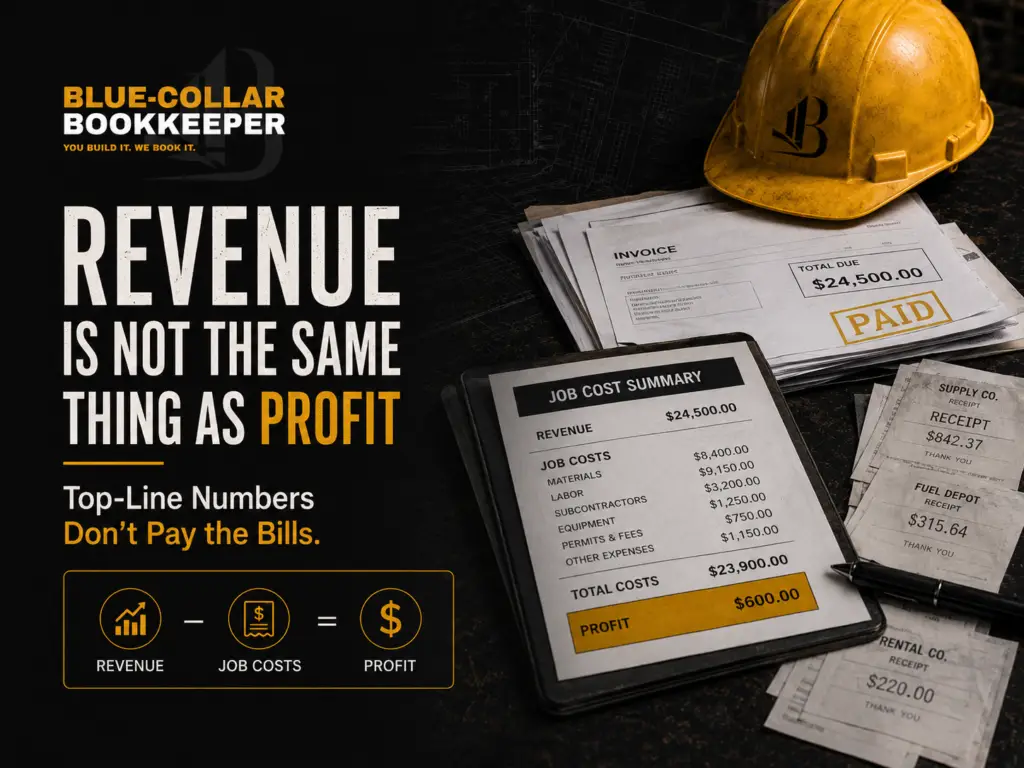
Revenue Is Not the Same Thing as Profit
One of the easiest traps for contractors is looking at revenue and assuming the business is doing well.
Revenue can lie to you.
A $40,000 job sounds great until you look at the actual numbers.
Maybe materials ran higher than expected. Maybe the crew spent three extra days on the job. Maybe you had to bring in a subcontractor you didn’t plan for. Maybe there was a change order that never got billed correctly. Maybe the customer still owes the final $8,500.
On paper, it looks like a good job.
In reality, the profit may be thin.
That’s why clean books have to show more than deposits and expenses. They need to help you understand what’s left after the real cost of the work.
For contractors, that means tracking things like:
- Materials
- Labor
- Subcontractors
- Equipment rentals
- Dump fees
- Permits
- Job supplies
- Customer deposits
- Progress payments
- Final balances
- Change orders
If those numbers are all lumped together, you’re guessing.
And guessing is a rough way to run a contracting business.
A Common Contractor Example
Let’s say a roofing contractor has what looks like a strong month.
He completes three jobs and brings in $92,000 in revenue.
At first glance, that looks like a win.
But then the real numbers start showing up.
The supplier bill comes in at $31,000. Crew payroll is $18,500. Subcontractors cost $9,200. Dump fees, fuel, permits, and job supplies add another $5,800. Insurance, software, truck payments, phone bills, and other overhead take another $11,000.
Now the business is down to $16,500 before taxes, owner pay, debt payments, and anything that was underbid.
Then one customer still owes $7,400 on a final invoice.
Suddenly that $92,000 month does not feel nearly as strong.
The contractor was busy. The jobs got done. The revenue came in.
But without clean books, he may not see the real story.
One job may have had a healthy margin. One may have barely broken even. One may have looked profitable only because a supplier invoice had not been entered yet.
That’s the difference between having numbers and having useful numbers.

Your Bank Balance Can Fool You
A lot of contractors check the bank account and use that as the scoreboard.
That’s understandable. It’s fast. It’s simple. It tells you what’s sitting there right now.
But your bank balance doesn’t tell the whole truth.
You might have $35,000 in the bank today, but that doesn’t mean you have $35,000 available.
Some of that money may already be spoken for.
You may still need to cover:
- Payroll
- Supplier bills
- Subcontractor invoices
- Credit card payments
- Loan payments
- Sales tax or payroll tax
- Income tax set-asides
- Upcoming material orders
- Insurance
- Software and admin expenses
That’s why contractors can have money in the bank and still feel pressure.
Clean books help separate money that’s truly available from money that is already committed.
That one change can make a big difference.
It helps you stop making decisions based only on what the bank account says today.
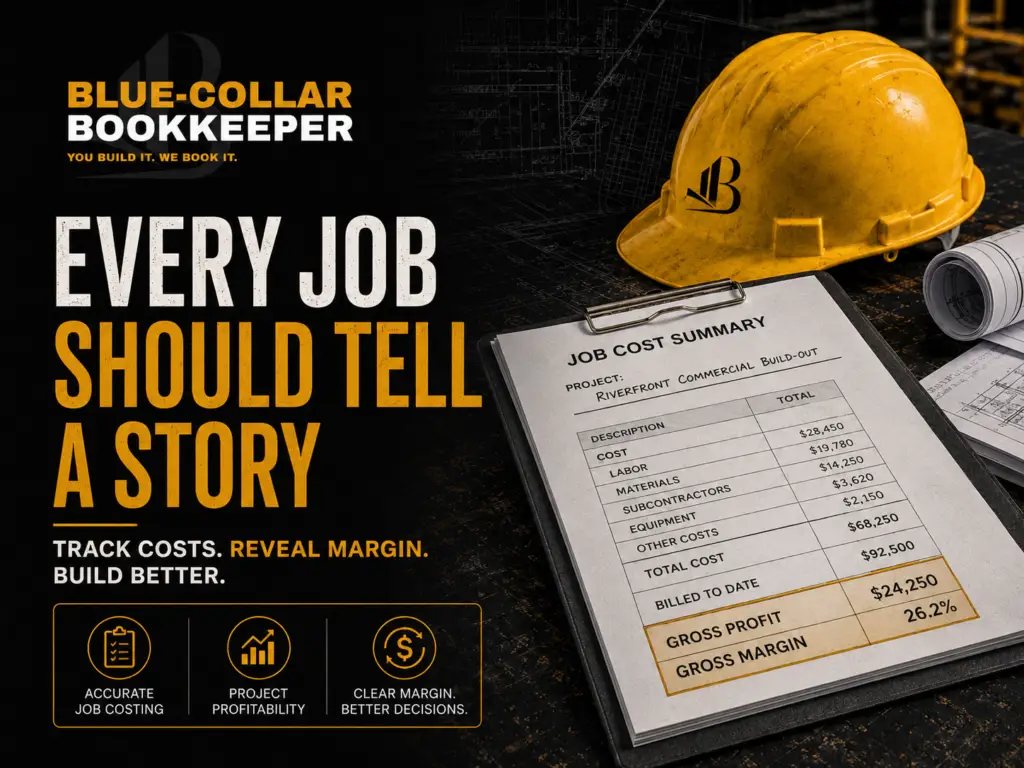
Every Job Should Tell a Story
A completed job should tell you more than “paid” or “not paid.”
It should show whether the work was worth doing.
A good bookkeeping system should help answer:
- Did we price this job correctly?
- Did materials come in higher than expected?
- Did labor run over?
- Did we collect the full amount?
- Did change orders get billed?
- Did subcontractors eat up too much margin?
- Did this type of job actually make money?
Contractors don’t need complicated reports just for the sake of having reports.
But you do need to know whether the jobs you are taking are helping or hurting the business.
If you keep winning jobs that don’t leave enough profit, you’re not growing. You’re just buying yourself more work.
Clean books help you see that before it becomes a bigger problem.
Job Costs and Overhead Should Not Be Mixed Together
One of the biggest bookkeeping problems for contractors is throwing everything into broad expense categories.
Materials, tools, fuel, subcontractors, office supplies, insurance, software, meals, and truck expenses all get mixed together.
The expenses may technically be recorded, but they aren’t very useful.
Contractors need to know the difference between job costs and overhead.
Job costs are tied to a specific job.
That may include materials, labor, subcontractors, permits, equipment rentals, dump fees, and job-specific supplies.
Overhead is what it costs to keep the business running whether you have that job or not.
That may include insurance, software, bookkeeping, phones, office expenses, marketing, vehicle costs, and general admin costs.
Both matter.
But if they’re not separated clearly, your reports can get muddy fast.
You may think your jobs are profitable when they’re not. You may think overhead is the problem when the real issue is underpriced work. Or you may blame a slow month when the problem is actually poor tracking.
Clean books bring those numbers into focus.
You Should Know Who Owes You Money
A contractor can be busy, booked, and still get squeezed because customers are slow to pay.
That’s why accounts receivable matters.
You need to know:
- Who owes you money
- How much they owe
- How long the invoice has been open
- Which jobs are waiting on final payment
- Which customers need follow-up
- Whether late payments are creating cash-flow problems
This is especially important when you’re buying materials up front or paying crews before the customer has fully paid you.
If your books don’t clearly show what’s owed to you, you may be making decisions with only half the picture.
You Should Also Know What You Owe
Money coming in is only part of the picture.
You also need to know what’s coming due.
Supplier bills. Subcontractor invoices. Credit cards. Equipment payments. Payroll. Insurance. Taxes.
These obligations can pile up quietly if the books aren’t current.
That is how a contractor gets surprised.
The job looked profitable, but the material bill had not been entered. The bank account looked fine, but payroll and a supplier payment were both due the same week. The owner took a draw, but taxes had not been set aside.
Clean books should help prevent those surprises.
They should give you a clear view of what the business owes before the bills become a problem.
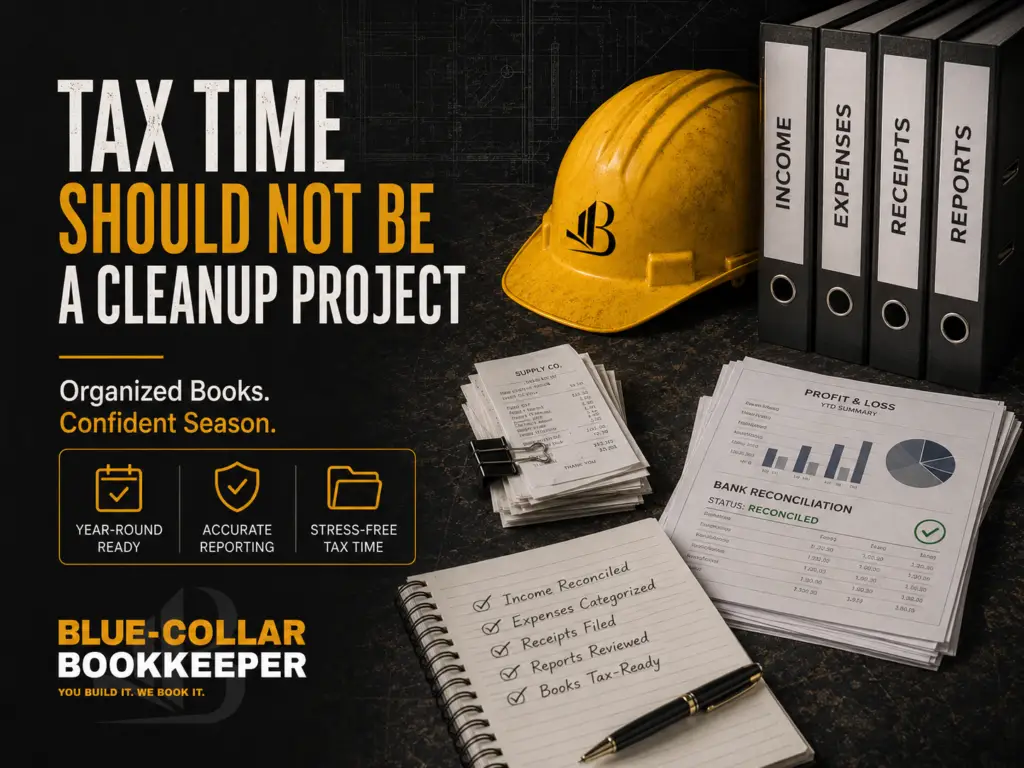
Tax Time Should Not Be a Cleanup Project
A lot of contractors wait until tax season to find out their books are a mess.
That’s a painful way to do it.
By then, you’re digging through receipts, matching old transactions, trying to remember what a charge was from eight months ago, figuring out which payments went to subcontractors, and answering questions from your tax preparer when you’re already busy.
Tax time shouldn’t be the first time your books get attention.
Clean books help you stay closer to tax-ready throughout the year.
That means:
- Transactions are categorized properly
- Bank and credit card accounts are reconciled
- Subcontractor payments are tracked
- Owner draws are separated from expenses
- Loan payments are recorded correctly
- Equipment purchases aren’t buried in the wrong place
- Income is organized
- Reports are easier for your tax preparer to use
Your bookkeeper doesn’t replace your CPA or tax preparer.
But clean bookkeeping makes tax season a whole lot less stressful.

The Numbers Contractors Should Know Every Month
You don’t need to live inside QuickBooks.
You don’t need to become an accountant.
But as the owner, you should know the basic numbers that tell you how the business is doing.
At a minimum, contractors should have a clear monthly view of:
1. Revenue
How much money came in?
Not just what was invoiced. Not just what you hope to collect. What actually came in?
2. Gross profit
After job costs like materials, labor, and subcontractors, what’s left?
This is where a lot of problems show up.
3. Overhead
What does it cost to keep the business running every month?
If overhead is creeping up, you need to know.
4. Net profit
After job costs and overhead, what did the business actually make?
This is the number that matters more than revenue.
5. Accounts receivable
Who still owes you money?
If customers are slow to pay, your cash flow will feel it.
6. Accounts payable
What bills are coming due?
You should not be surprised by supplier bills, credit cards, or subcontractor invoices.
7. Cash position
How much cash is available after upcoming obligations are considered?
This is different from just checking the bank balance.
8. Job profitability
Which jobs made money, which jobs were tight, and which jobs need a closer look?
This is where contractors can start making better decisions.
Signs Your Books Aren’t Telling the Truth
Most contractors know when something feels off.
You may not know exactly what’s wrong, but you can feel it.
Here are some signs your books may need cleanup or better monthly attention:
- You don’t know which jobs are most profitable
- You feel busy but not more profitable
- Your QuickBooks balance doesn’t match your bank account
- You have a lot of uncategorized transactions
- You’re behind on reconciliations
- You only look at your books at tax time
- You’re not sure who still owes you money
- Supplier bills catch you off guard
- You don’t know how much to set aside for taxes
- Materials and subcontractors aren’t tied to jobs
- Owner draws and business expenses are mixed together
- You can’t explain where the money went
If that sounds familiar, it doesn’t mean you’re bad at business.
It usually means the bookkeeping system hasn’t kept up with the business you’re running.
That can be fixed.

Clean Books Help You Make Better Decisions
The point of bookkeeping isn’t to make your business look organized on paper.
The point is to help you run the business with better information.
When your books are clean, you can make decisions with more confidence.
You can see whether your pricing needs to change. You can spot jobs that are not worth chasing. You can follow up on unpaid invoices faster. You can plan for taxes before they become a problem. You can understand whether growth is actually helping the business or just creating more pressure.
That’s what contractor bookkeeping should do.
It should turn the numbers into something useful.
Not fancy. Not complicated. Useful.
Bookkeeping Built for Contractors
Contractors don’t need bookkeeping that sounds good in a conference room but doesn’t match the way the trades actually work.
You need books that reflect real jobs, real costs, real cash flow, and real pressure.
At The Blue-Collar Bookkeeper, we help contractors get clearer numbers behind the business.
That may mean cleaning up books that have fallen behind. It may mean keeping monthly books current. It may mean helping you understand job costs, cash flow, reports, and tax-ready records.
The goal is simple:
Help you stop guessing.
Because if your books are clean, they should show you what is really happening in your business.
And once you can see it, you can do something about it.
Get a Clearer Look at Your Numbers
If your contracting business is busy but the money still feels unclear, your books may not be telling you enough.
The Blue-Collar Bookkeeper helps contractors clean up the numbers, understand what’s happening, and stay more organized month to month.
We’ll take a look at where your books stand, what may be unclear, and what it would take to get your numbers working for you instead of against you.
Start with a free financial consultation.
You build it. We book it.
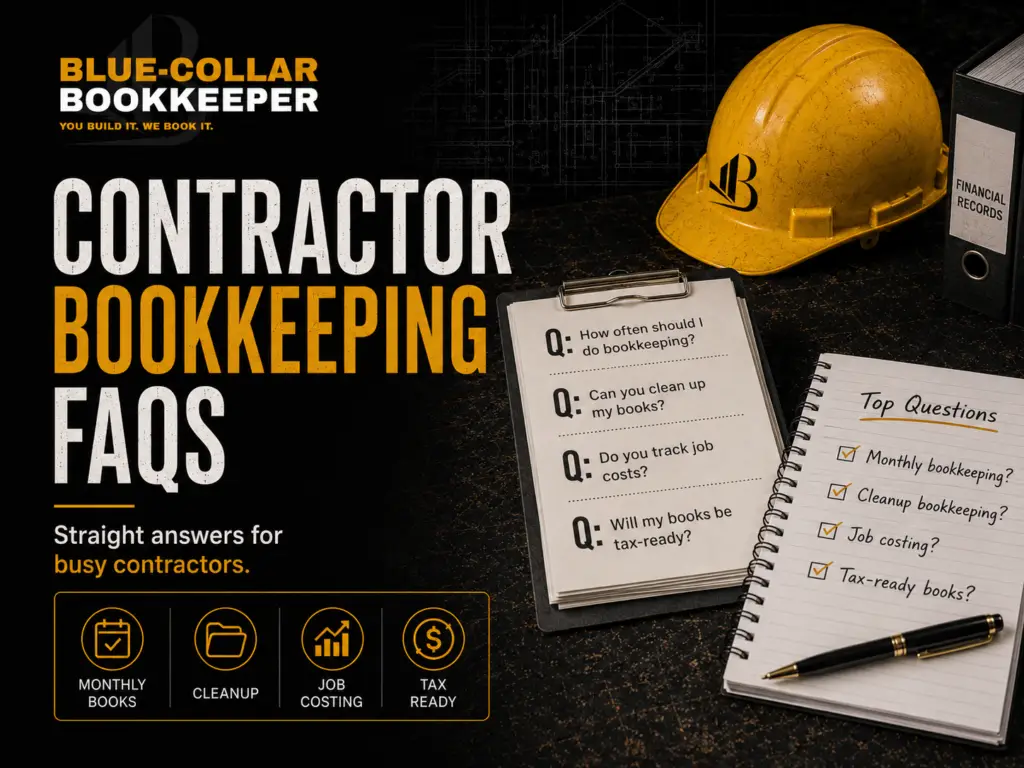
Frequently Asked Questions About Bookkeeping for Contractors
What makes bookkeeping for contractors different?
Contractors have more moving parts than many other businesses. You may have materials, labor, subcontractors, deposits, progress payments, change orders, equipment, permits, job delays, and customer balances all tied to different projects.
Good contractor bookkeeping needs to account for those details. Otherwise, the reports may show income and expenses but still miss what matters most.
How do I know if my contractor books are messy?
Your books may need attention if you have uncategorized transactions, unreconciled accounts, missing receipts, unpaid invoices you are not tracking, supplier bills that surprise you, or QuickBooks numbers that don’t match your bank account.
Another big warning sign is not knowing which jobs actually made money.
What is the difference between monthly bookkeeping and cleanup bookkeeping?
Cleanup bookkeeping is for getting behind or messy books caught up and corrected.
Monthly bookkeeping is the ongoing work of keeping your books current, categorized, reconciled, and useful each month.
Many contractors need cleanup first, then monthly bookkeeping afterward so the books don’t fall behind again.
Should contractors track profit by job?
Yes, if you want to know which jobs are actually worth doing.
Job profitability helps you understand whether your pricing, labor, materials, and subcontractor costs are working. Without it, you may keep taking jobs that look good on the surface but don’t leave enough profit.
Is checking my bank account enough to manage cash flow?
No.
Your bank account tells you what is there today. It doesn’t always show what bills are coming due, what taxes should be set aside, what customer payments are late, or what money is already committed to upcoming jobs.
Clean books give you a better view of cash flow than the bank balance alone.
Do I still need a CPA if I have a bookkeeper?
Yes. A bookkeeper and a CPA usually serve different roles.
A bookkeeper keeps your records organized and current. A CPA or tax preparer handles tax strategy, filing, and tax advice. Clean bookkeeping can make your CPA’s job easier and help reduce the tax-time scramble.
How often should contractors review their books?
At minimum, monthly.
Waiting until tax season is too late. Monthly reviews help you catch issues earlier, understand cash flow, track job profitability, and make better decisions before small problems turn into expensive ones.
What should I do if my books are behind?
Start with a review.
You need to know how far behind the books are, what needs to be cleaned up, whether accounts are reconciled, and whether the reports can be trusted.
From there, you can decide whether you need cleanup bookkeeping, monthly bookkeeping, or both.