
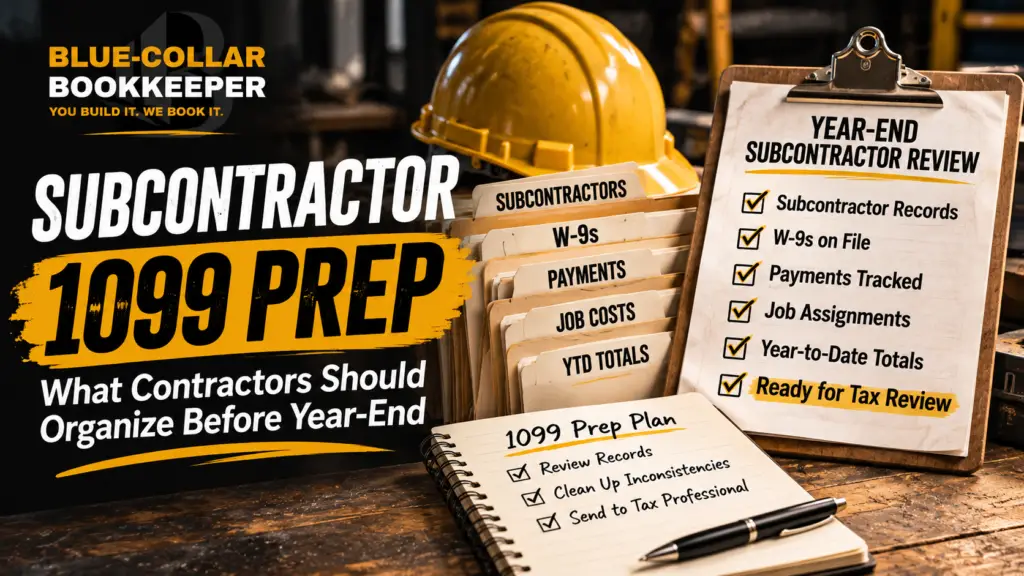
You paid subcontractors all year.
Now year-end is getting closer, and suddenly somebody needs to know exactly who was paid, how much they were paid, whether a W-9 is on file, how the payments were made, and whether the records in your books actually match the people and businesses you hired.
That’s when subcontractor 1099 prep can turn into a scramble.
The problem usually didn’t start in December. It started months earlier when a subcontractor was added without a clean vendor record, a W-9 never made it into the file, or payments were recorded under different names.
Good year-end preparation isn’t about rebuilding twelve months of information at the last minute. It’s about keeping subcontractor records organized as part of your regular bookkeeping.
tax-ready books for contractors make that year-end review a lot easier.
Subcontractor Tracking and 1099 Prep Are Connected, but They’re Not the Same Thing
If you already track subcontractors by job, you’ve got part of the system in place.
But job costing and 1099 preparation answer different questions.
Job costing helps you understand things like:
- Which subcontractor worked on a particular project?
- How much did that subcontractor cost the job?
- Did subcontractor costs come in above or below what you expected?
- How did those costs affect the profitability of the project?
Year-end subcontractor records answer another set of questions:
- Who did the business actually pay?
- Is each subcontractor recorded under the correct name?
- Is the necessary vendor information on file?
- How much was paid during the year?
- How were those payments made?
- Are the records organized enough for your tax professional to review?
You need both.
Knowing what a subcontractor cost a job doesn’t automatically mean your year-end vendor records are clean. And having a year-to-date payment total doesn’t tell you whether those costs were assigned to the right projects.
That’s why tracking materials, labor, and subcontractors should connect with, rather than replace, your year-end recordkeeping process.
Start With a Clean Subcontractor Record
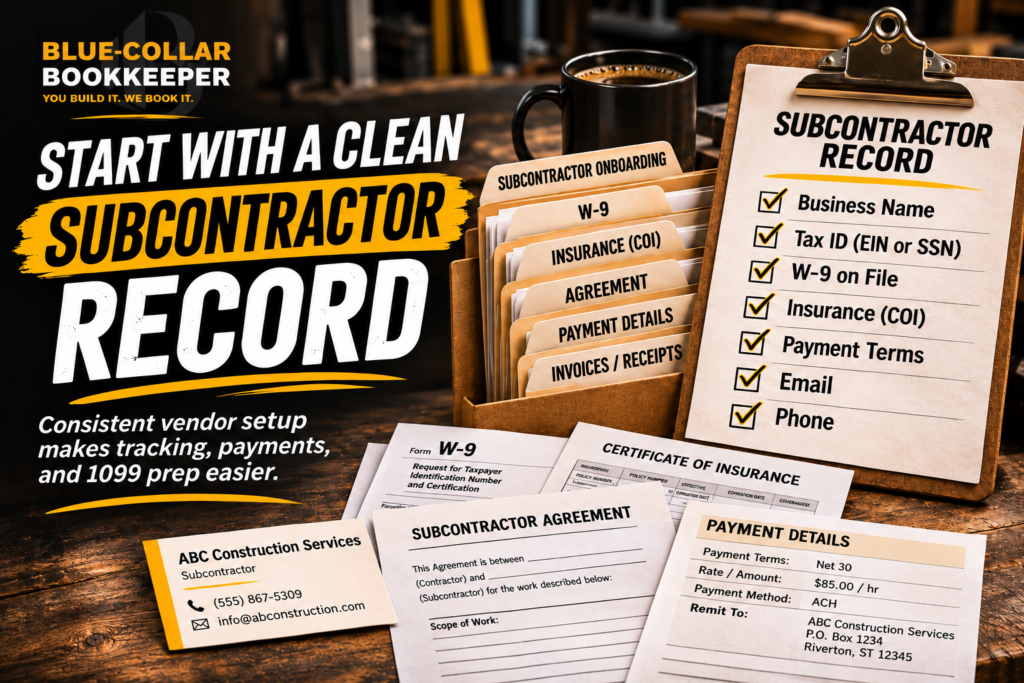
The easiest time to organize a subcontractor isn’t after you’ve paid them twelve times.
It’s when they first enter your bookkeeping system.
A clean vendor record gives every future payment one consistent place to go. That sounds simple, but inconsistent vendor setup can create a surprisingly messy year-end review.
Keep the Name and Business Information Consistent
Suppose you hire an electrician named Michael Reed who operates as MR Electric LLC.
Over the course of the year, transactions might accidentally get recorded under:
- Michael Reed
- Mike Reed
- MR Electric
- MR Electric LLC
To the person entering a transaction, those may all look like the same subcontractor.
To your bookkeeping system, they may look like four separate vendors.
That can split the payment history and make the year-to-date total harder to trust.
The goal isn’t complicated. You want one clean, consistent vendor record that connects the subcontractor to the payments recorded in the books.
Get the W-9 Information Early
A W-9 provides identifying information used for tax reporting, including the payee’s name and taxpayer identification number.
From a bookkeeping standpoint, waiting until year-end to chase that information creates an unnecessary problem.
A better process is to make W-9 collection part of setting up the subcontractor.
That way, when year-end arrives, you’re reviewing the information already on file rather than trying to find someone you haven’t worked with in eight months.
This doesn’t mean the bookkeeper should decide every tax question connected to that subcontractor. It means the records should be complete enough for the qualified tax professional to make those decisions.
Track Every Subcontractor Payment Under the Right Vendor
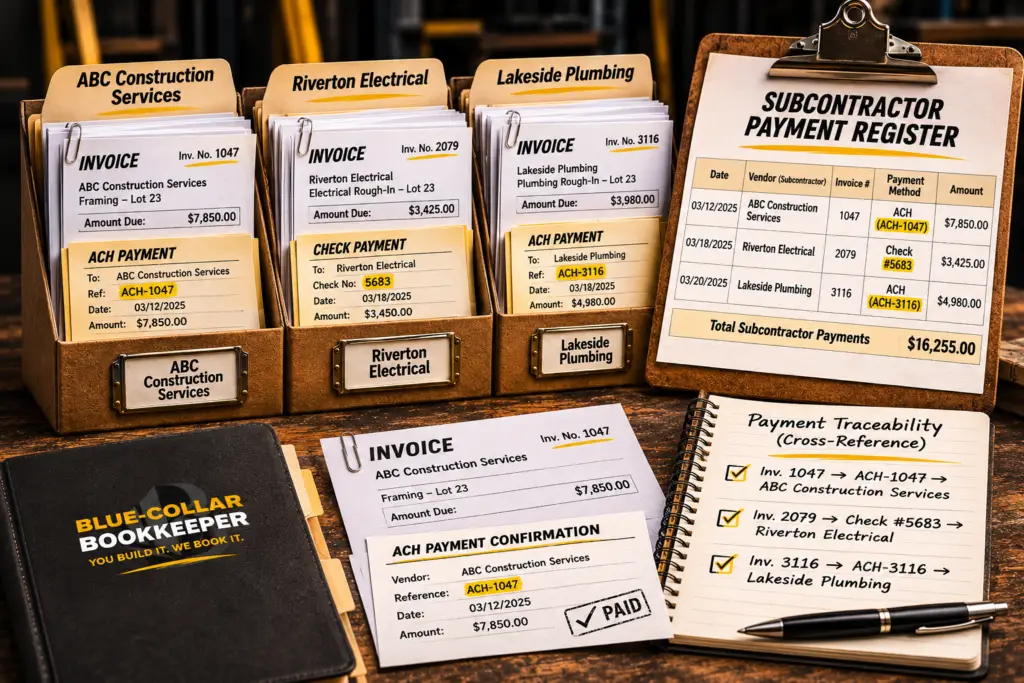
Once the vendor record is clean, every payment needs to land in the right place.
That includes payments made by check, ACH, electronic payment services, and other methods your business uses.
Problems start when payments get scattered.
One check goes to the correct vendor. Another transaction gets entered under a shortened name. Another gets posted to a generic subcontractor expense category without a clear vendor attached.
By December, the books may contain all the transactions, but that doesn’t mean you can easily answer:
How much did we actually pay this subcontractor during the year?
That’s why monthly bookkeeping matters.
A monthly process gives you repeated opportunities to catch inconsistent vendor names, missing details, miscoded transactions, and duplicate records before they accumulate for an entire year.
Connect Subcontractor Payments to the Right Job
Contractors need another layer of detail that many other small businesses don’t.
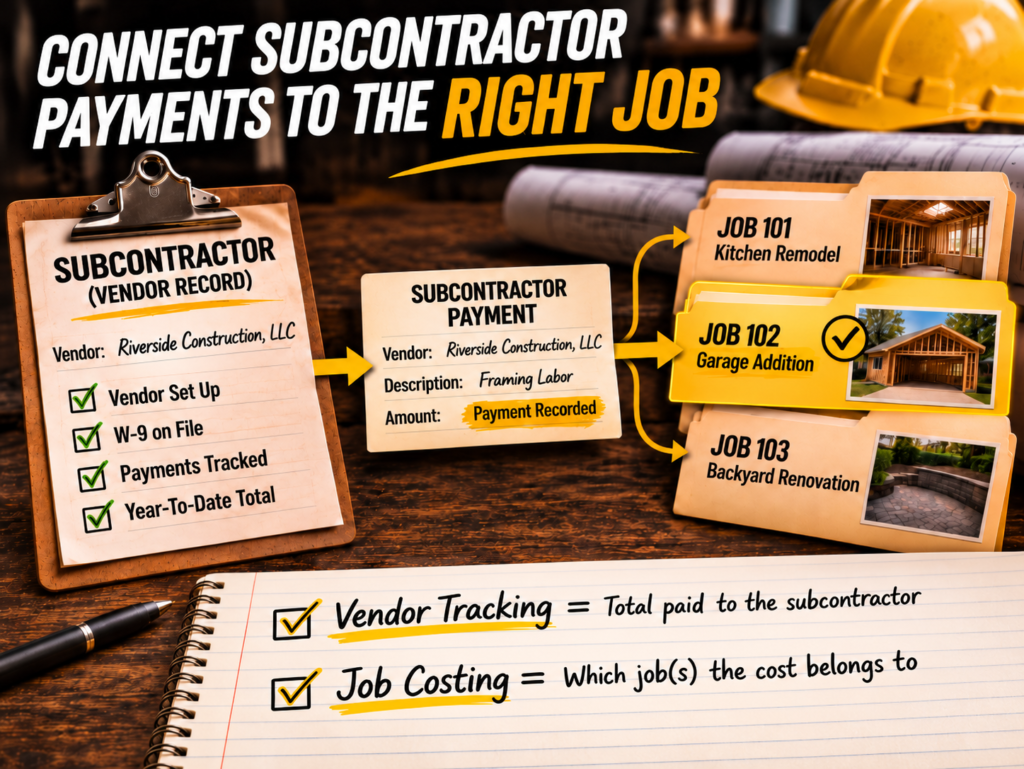
You don’t just need to know that $1 went to a subcontractor. You need to know which job that cost belonged to when job costing applies.
A clean system should help answer two separate questions:
- How much did we pay this subcontractor during the year?
- Which projects did those subcontractor costs belong to?
Those are different views of the same transactions.
The vendor record helps with year-end subcontractor tracking.
The job assignment helps you understand what the project actually cost.
If the vendor information is clean but the project assignment is missing, your year-end records may be easier to review while your job profitability remains unclear.
If the project assignment is correct but payments are scattered across duplicate vendor records, your job-costing information may look fine while year-end subcontractor totals become harder to verify.
Good bookkeeping keeps both connected.
job costing and profitability reports can then give you a clearer picture of how subcontractor costs affected individual projects.
Review Year-to-Date Subcontractor Totals Before Year-End
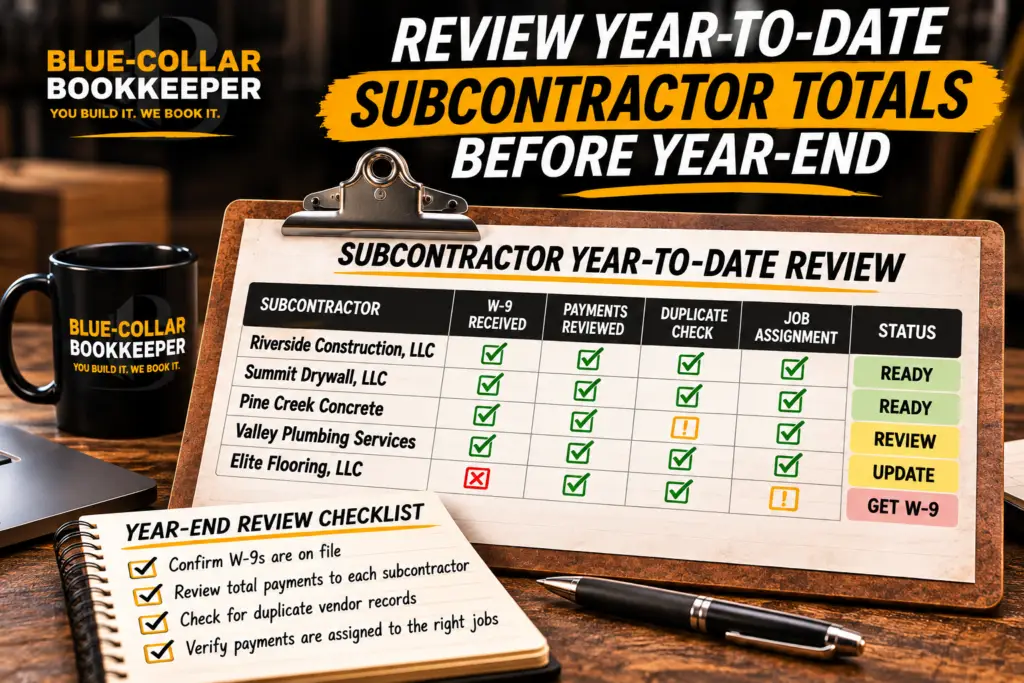
You don’t need to wait until tax season to find out whether your subcontractor records make sense.
A periodic review can catch problems while there’s still time to straighten them out.
Look at who has been paid during the year and whether the records behind those payments are complete.
Are there duplicate vendor names?
Is subcontractor information missing?
Are payments sitting in generic or uncategorized accounts?
Are job assignments missing?
Does a year-to-date total look unusual compared with what you expected to pay that subcontractor?
Can you clearly identify how the payments were made?
The goal isn’t to make the tax determination during this review.
The goal is to make sure the underlying bookkeeping can be trusted.
If something looks wrong in October, you have time to investigate it.
If you first discover it while year-end forms are being prepared, the same problem becomes much more urgent.
The 2026 1099 Reporting Threshold Changed
There’s an important current-year change contractors should know about.
For qualifying payments made during 2026, the federal information-reporting threshold applicable to Form 1099-NEC increased to $2,000. Before 2026, the threshold was $600.
That makes 1099 reporting threshold 2026 a relevant issue for contractors reviewing subcontractor activity this year.
But the number by itself doesn’t tell you whether a particular payment or payee requires a form.
The type of payment, the recipient, how the payment was made, backup withholding, and other circumstances can matter.
So don’t treat “$2,000” as a complete decision rule.
Your bookkeeping should establish the facts:
- who was paid
- how much was paid
- what the payment was for
- how it was paid
- what vendor information is on file
Then your qualified tax professional can determine the applicable reporting treatment.
Bookkeeping Prepares the Records. Your Tax Professional Makes the Filing Call.
There’s an important line between clean bookkeeping and tax compliance.
Your bookkeeper can help maintain organized subcontractor and vendor records, track payments, reconcile transactions, identify missing information, and provide year-to-date totals.
That’s the preparation side.
Questions such as whether a particular worker has been properly classified, whether a specific payee requires an information return, whether an exception applies, or how a particular filing rule applies to your business belong with a qualified tax professional.
That distinction matters.
The goal of tax-ready bookkeeping isn’t for your bookkeeper to guess at a tax decision.
It’s to give your tax professional clean information so they don’t have to untangle the books before they can answer the question.
Blue-Collar Bookkeeper’s Tax Strategy and Filing Support connects clean bookkeeping with qualified tax support when those tax-specific questions need to be addressed.
A Monthly Subcontractor Review Is Easier Than a Year-End Reconstruction
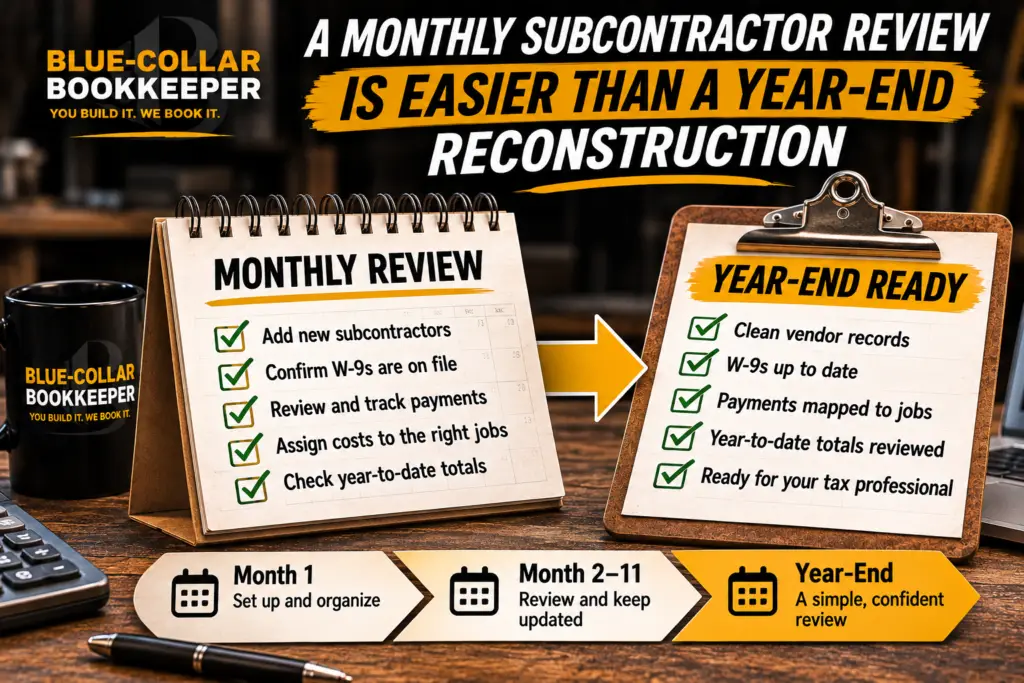
The simplest way to make subcontractor 1099 prep easier is to stop treating it like a once-a-year project.
When a new subcontractor is added, create a consistent vendor record, collect the appropriate information, and establish how their costs will be tracked.
During the year, make sure payments continue going to that vendor record and, when applicable, to the right job.
Periodically review year-to-date activity for duplicate vendors, missing information, uncategorized payments, and other inconsistencies.
Then, before year-end, perform a focused review of subcontractor activity and resolve bookkeeping questions before the records go to the tax professional.
That turns year-end preparation into a review of information you already maintain instead of a reconstruction of what happened months ago.
That’s what good contractor bookkeeping should do. It should make important business information easier to find when you need it.
A Simple Example: One Subcontractor, Three Recordkeeping Problems
Imagine a contractor hires the same electrician throughout the year.
The first few payments are entered under the electrician’s personal name.
Later payments are entered under the company name.
One more payment gets categorized as a subcontractor expense without being connected to either vendor record.
The jobs themselves may have been completed correctly. The subcontractor may have been paid correctly. The money may have left the bank exactly as expected.
But the bookkeeping now tells an incomplete story.
When year-end arrives, the contractor has to figure out whether all three records belong to the same subcontractor, combine the payment history, verify the vendor information, confirm the W-9 on file, and make sure the records sent for tax review are complete.
Nothing about that situation requires a dramatic bookkeeping disaster.
It’s simply the result of small inconsistencies adding up over the year.
A clean vendor setup and regular monthly review could have caught the problem much earlier.
Subcontractor 1099 FAQs
What is a subcontractor 1099?
People often use “subcontractor 1099” to describe Form 1099-NEC reporting connected with payments for services performed by someone who isn’t an employee.
Whether a particular subcontractor or payment requires a form depends on the applicable tax rules and facts, so the final determination should be made with a qualified tax professional.
When should I get a W-9 from a subcontractor?
From a bookkeeping-process standpoint, collecting the appropriate vendor information when the subcontractor is set up is much easier than chasing it at year-end.
That gives you time to resolve missing or inconsistent information before year-end reporting becomes urgent.
How should contractors track subcontractor payments?
Keep payments attached to a consistent vendor record and, when job costing applies, connect those costs to the appropriate project.
That lets you review both the total paid to the subcontractor and the jobs that generated those costs.
What is the 1099 reporting threshold for 2026?
For qualifying payments made during 2026, the federal information-reporting threshold applicable to Form 1099-NEC is $2,000.
That threshold is only one part of determining whether reporting is required. Other facts and exceptions may apply.
Does every subcontractor get a 1099?
No single rule like “every subcontractor gets a 1099” is accurate for every situation.
The business should maintain complete payment and vendor records and let the qualified tax professional determine the reporting requirement based on the actual facts.
What if I paid the same subcontractor under different vendor names?
Those records should be reviewed and reconciled so the books accurately reflect the subcontractor’s payment history.
Leaving duplicate vendors unresolved can make year-to-date totals harder to verify.
Is subcontractor tracking part of job costing?
It can be.
Job costing tracks subcontractor costs to specific projects. Year-end vendor tracking looks at the subcontractor’s overall payment history and records.
Strong bookkeeping supports both views.
Get the Records Ready Before Tax Time Gets Busy
You shouldn’t have to spend January rebuilding information that could have been maintained throughout the year.
A clean subcontractor record should help you see who was paid, how much they were paid, which jobs those costs belonged to, what information is missing, and what needs to be reviewed by your tax professional.
If you’re heading toward year-end and aren’t sure whether your subcontractor records, receipts, vendor information, and other bookkeeping details are ready, start with the Contractor Tax-Ready Checklist.
If the review shows that your books are already too messy to trust, Blue-Collar Bookkeeper can help you figure out what needs attention and what comes next.
We’ll take a look at where your books stand, what may be unclear, and what it would take to get your numbers working for you instead of against you.
Start with a free financial consultation.
You build it. We book it.