

You can finish the work, send the invoice, and still be waiting on the money when payroll, supplier bills, and subcontractors need to be paid.
That’s one of the frustrating parts of running a contracting business.
The jobs may be selling. The crew may be busy. The work may even be profitable.
But if too much money is still sitting in unpaid invoices, the bank account can tell a very different story.
That’s where construction accounts receivable matters.
Accounts receivable isn’t just an accounting term. It’s a way of seeing what customers still owe your business, how long those balances have been outstanding, and which payments may need attention.
For contractors, that visibility can be especially important because money often moves in stages. Deposits come in before work starts. Progress payments may happen during the project. Change orders can increase the final bill. A balance may remain after the work is complete.
If those pieces aren’t tracked clearly, it becomes much harder to understand what money is actually available and what money you’re still waiting to collect.
That’s one of the reasons cash flow for contractors can look very different from the amount of work being completed.
What Construction Accounts Receivable Actually Means
In plain English, accounts receivable is money customers owe your business for amounts you’ve billed but haven’t collected yet.
Suppose you send a customer a $15,000 invoice.
The invoice exists.
The customer owes you $15,000.
But until that payment arrives, you don’t have $15,000 of additional cash sitting in the bank.
That distinction sounds simple, but it becomes harder to follow when a contractor has several active projects, multiple invoices per project, change orders, customer deposits, partial payments, and final balances all moving at the same time.
That’s why contractor accounts receivable needs more than a mental list of who still owes money.
The owner should have a reliable way to see what has been billed, what has been collected, and what remains outstanding.
One accounting note matters here.
Exactly how an unpaid invoice appears on formal financial reports can depend on whether the business uses cash-basis or accrual-basis accounting and how its books are configured. The operational issue is the same either way: money that hasn’t been collected isn’t available to spend.
That’s where clear accounts receivable and accounts payable support can become useful.
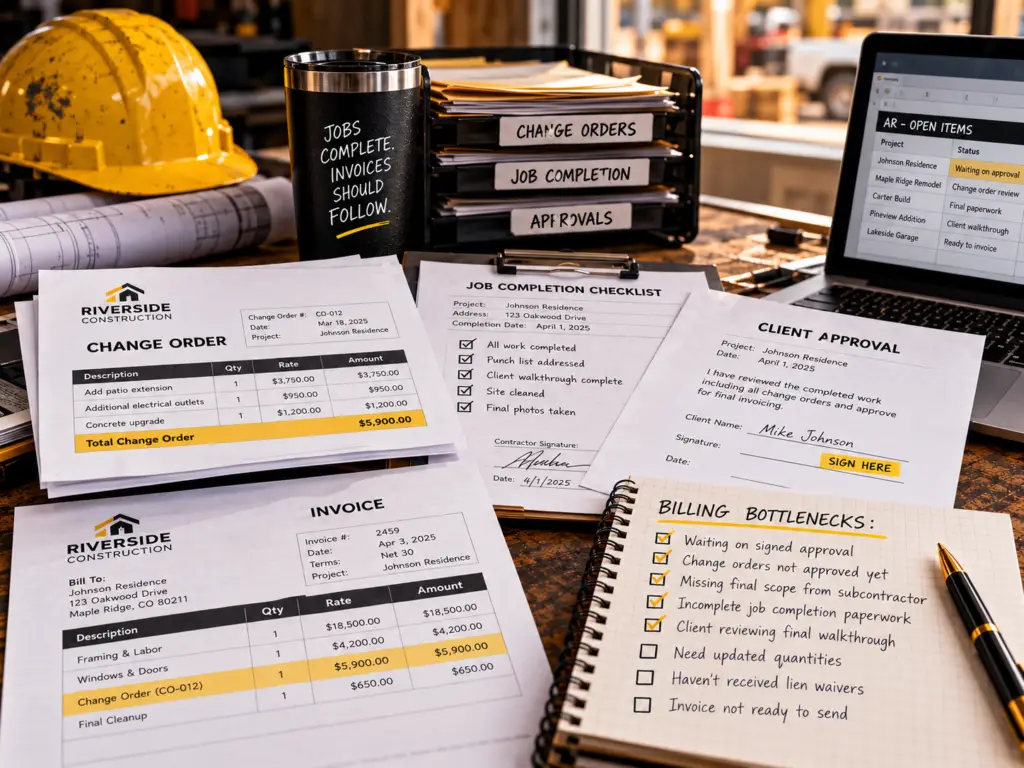
Where Contractor Receivables Commonly Get Stuck
Not every receivable problem starts because somebody refuses to pay.
Sometimes the problem begins before the invoice is even overdue.
Contracting businesses can have several billing points inside one project, and every one of them creates an opportunity for something to be missed.
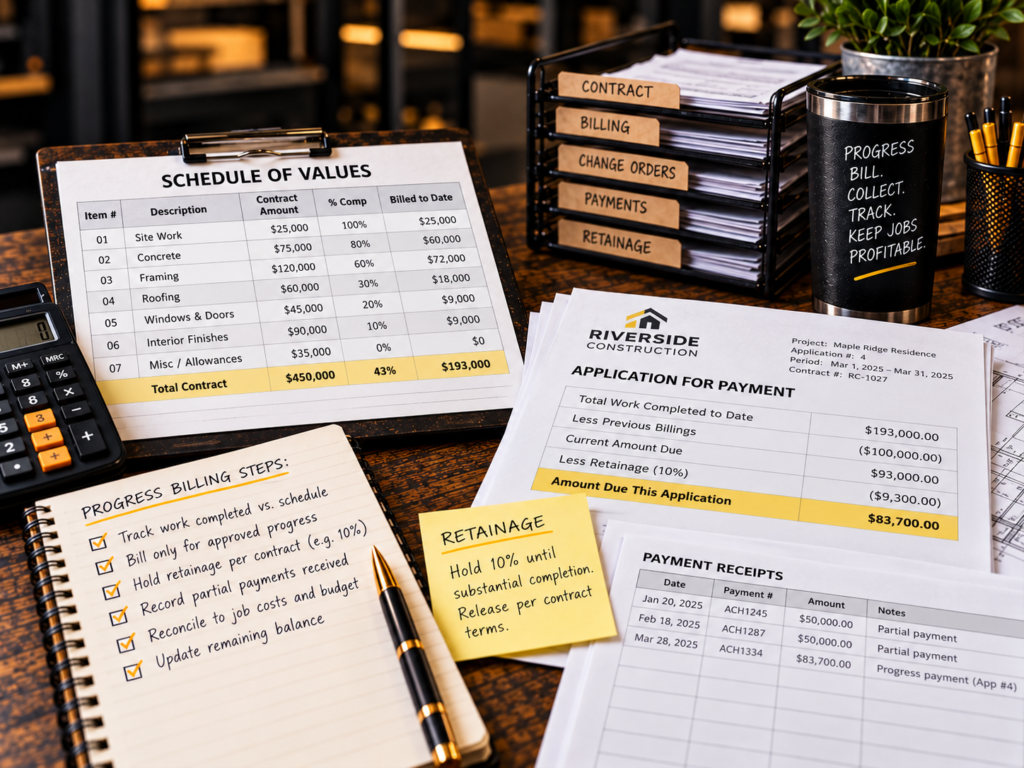
Deposits and Progress Payments
Some contractors collect deposits before work begins.
Others use progress billing tied to project stages.
The exact structure depends on the type of work, agreement, and business.
What matters from a bookkeeping perspective is knowing whether the expected payment was actually billed and collected.
If the next phase of work begins while an earlier payment is still outstanding, the contractor may continue spending money on labor, materials, and subcontractors while waiting on cash from work already performed.
Final Invoices
Finishing the work doesn’t automatically mean the final invoice was sent.
That sounds obvious, but busy contractors move quickly.
The crew finishes one project and starts another. The owner is estimating the next job. Somebody needs an answer from a supplier. A customer calls about something unrelated.
Meanwhile, the final invoice is still waiting to go out.
Or maybe it was sent but nobody has reviewed whether it was paid.
An unfinished billing process can leave completed work sitting in outstanding invoices longer than anyone realizes.
Change Orders
Change orders can create another gap.
A customer approves additional work.
Materials increase.
Labor increases.
Maybe another subcontractor gets involved.
The work gets completed, but the approved change doesn’t always make it cleanly from the project into the final billing.
That can create a strange situation where the books contain the added project costs but the customer hasn’t yet been billed for all of the approved additional work.
Tracking approved changes through billing helps keep those amounts from disappearing between the jobsite and the office.
Retainage or Other Held Balances
Some construction contracts involve retainage or other amounts that aren’t due until specific conditions are satisfied.
Not every contractor deals with this, and contract requirements vary.
From a bookkeeping standpoint, the important thing is simply knowing that the money is still outstanding and understanding why.
Questions about legal rights, payment deadlines, liens, or enforcement should be addressed with an appropriate legal professional when necessary.

An Invoice Aging Report Tells You More Than the Total
Knowing that customers owe you $40,000 is useful.
Knowing which $40,000 you’re looking at is much more useful.
That’s what accounts receivable aging helps show.
An aging report groups outstanding invoices based on how long they’ve remained unpaid.
Depending on the bookkeeping setup, you may see categories such as:
- current
- 1 to 30 days
- 31 to 60 days
- 61 to 90 days
- more than 90 days
The exact buckets aren’t the important part.
The point is visibility.
A recently issued invoice is different from an invoice that has been sitting unpaid for three months.
When all outstanding balances are treated as one big number, that distinction disappears.
An invoice aging report gives the owner a better way to ask:
Which balances are recent?
Which ones are getting old?
Which customers have partially paid?
Which invoices need follow-up?
Are we counting on money that may not arrive when we expected?
Current monthly bookkeeping makes that information easier to maintain and review.
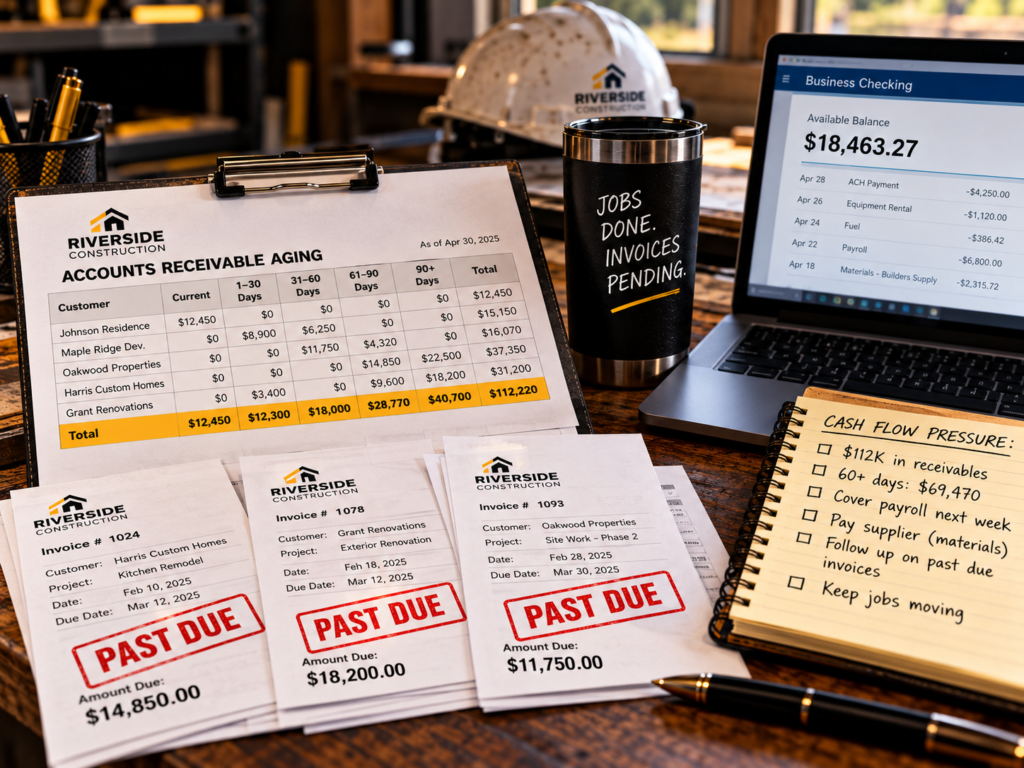
A Profitable Month Can Still Feel Cash Tight
Consider a simple example.
The numbers below are illustrative, not a Blue-Collar Bookkeeper client result.
A contractor bills $70,000 across several projects during the month.
By month-end:
- $12,000 from one project is still outstanding
- $7,500 remains unpaid on another
- a $4,000 approved change order still needs to be billed
- a $6,000 final invoice has been sent but hasn’t been paid
That’s $29,500 connected to completed or approved work that isn’t currently sitting in the bank account.
Meanwhile, the contractor may already have paid for materials.
Payroll has still happened.
Subcontractors may already be due.
Insurance, fuel, equipment payments, and other operating expenses don’t wait for customers to catch up.
That’s why profitable jobs can still leave you short on cash.
The answer isn’t automatically that the business is unprofitable.
The timing of collections may be part of the problem.
Job Profitability and Accounts Receivable Answer Different Questions
These two ideas are easy to mix together.
A job profitability report asks:
Did the revenue associated with this project exceed the costs required to complete it?
Accounts receivable asks:
How much of the money billed to the customer is still outstanding?
Those are different questions.
A project could perform well financially while the customer still owes a final balance.
The opposite can also happen.
A customer can pay everything they owe, but the project itself may still produce a disappointing margin because materials, labor, subcontractors, or other project costs ran higher than expected.
That’s why job profitability reports and accounts receivable records work better together than either one does alone.
One helps you understand what the project produced.
The other helps you understand whether the money has actually arrived.

What Contractors Should Review Regularly
Accounts receivable doesn’t need to become another complicated financial ritual.
The goal is to make outstanding money visible enough that it doesn’t disappear into the background.
A regular review might include:
- customer name
- project
- invoice date
- amount billed
- amount collected
- remaining balance
- how long the balance has been outstanding
- progress invoices that still need to be sent
- final invoices that still need to be sent
- approved change orders that haven’t been billed
- balances that need follow-up
Different contractors will need different levels of detail.
A business completing a few large projects may review receivables differently from a service contractor handling dozens of smaller jobs.
The bookkeeping system should fit the way the business actually operates.
The important part is that somebody can answer the question:
Who owes us money right now, and what needs attention?
Clean Monthly Bookkeeping Makes Receivables Easier to Trust
An accounts receivable report isn’t very helpful if the information behind it isn’t current.
Maybe a customer paid three weeks ago, but the payment hasn’t been matched correctly.
Maybe an invoice was entered twice.
Maybe a credit or partial payment wasn’t applied properly.
Maybe the work was completed but the final invoice never made it into the system.
Maybe an approved change order hasn’t been billed.
That’s why monthly bookkeeping for contractors supports more than tax preparation.
Regular bookkeeping gives the business a chance to reconcile activity, review customer balances, and identify items that don’t make sense while the project details are still relatively fresh.
That doesn’t mean the books will collect a late invoice for you.
It means the owner has a clearer picture of what’s actually outstanding.
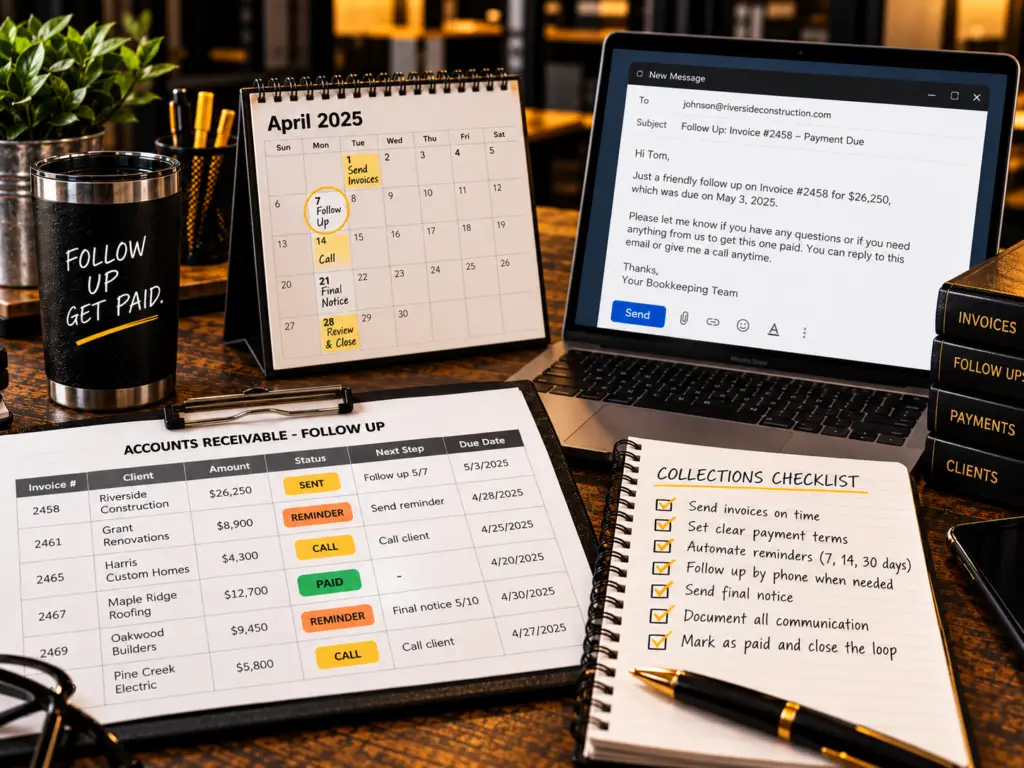
Accounts Receivable Management Isn’t the Same as Collections
There’s an important line here.
Bookkeeping and Accounts Receivable & Accounts Payable Management can help organize invoices, track balances, review aging, and make outstanding amounts easier to see.
That’s different from legal debt collection.
Questions involving liens, lawsuits, enforceability of contract terms, statutory notices, collection agencies, or other legal remedies depend on the contract and jurisdiction.
Those issues may require an attorney or another appropriately qualified professional.
The bookkeeping job is much more practical:
Keep the records current enough that the owner knows what’s owed, what’s been collected, and where something may need follow-up.
Construction Accounts Receivable FAQs
What is accounts receivable in construction?
Construction accounts receivable generally refers to amounts customers owe for work that has been billed but hasn’t yet been collected. Depending on the contractor, that might include progress invoices, final invoices, approved change orders, or other outstanding customer balances.
Why can a profitable contractor still be short on cash?
Profit and cash aren’t the same thing. A contractor can complete profitable work while some customer payments remain outstanding. At the same time, payroll, materials, subcontractors, and other expenses may still need to be paid.
What is an accounts receivable aging report?
An accounts receivable aging report organizes unpaid customer balances by how long they’ve been outstanding. It can help an owner distinguish recent invoices from balances that may need more attention.
How often should contractors review outstanding invoices?
There isn’t one schedule that fits every contractor. The right frequency depends on billing volume, payment terms, project length, and how quickly the business needs visibility into outstanding cash. The important thing is having a consistent review process.
Are change orders part of accounts receivable?
Once approved additional work has been properly billed, any unpaid balance can become part of the contractor’s outstanding receivables. The billing and accounting treatment can vary based on the business setup and contract.
Is accounts receivable the same as revenue?
Not necessarily. Accounts receivable represents amounts customers owe. How those amounts appear as revenue in formal financial statements can depend on the accounting method and bookkeeping setup.
Can bookkeeping help manage unpaid invoices?
Bookkeeping can help maintain accurate invoice records, customer balances, aging reports, and payment activity. That visibility can support a more consistent follow-up process, but bookkeeping doesn’t guarantee payment and isn’t a substitute for legal collection advice when a dispute becomes more serious.
Know What’s Owed Before Cash Gets Tight
A busy schedule doesn’t guarantee a healthy bank balance.
If completed work, progress invoices, final balances, and change orders are scattered across different places, it gets harder to know how much money is actually still outstanding.
Blue-Collar Bookkeeper helps contractors and small-business owners build clearer bookkeeping systems around cash flow, receivables, payables, reporting, and the numbers behind the work.
If your books are making it difficult to see who owes you money or what needs attention next, Book a Free Financial Consultation.