
A month can look busy without telling you much about how the business actually performed.
Sales came in. Bills got paid. Customers called. Work got completed. Money moved through the bank account.
Then the month ends.
If the only number you check is the bank balance, you’re seeing one small piece of the business.
That’s where a monthly bookkeeping review becomes useful.
The goal isn’t to spend hours studying accounting reports or turn yourself into your own accountant. It’s to develop a repeatable habit of looking at a few important numbers and asking better questions about what happened.
Your books should help you understand the business while there’s still time to do something with the information.
A Closed Month Isn’t Useful If Nobody Reviews It
Monthly bookkeeping does more than keep transactions organized.
When the books are current, they should help you see what came in, what went out, whether customers are paying, what expenses are changing, and whether the work you’re doing is producing the results you expected.
But reports don’t create clarity by themselves.
You can receive a profit and loss statement every month and never really look at it. You can know your revenue without understanding your profit. You can show a profit on paper and still wonder why the bank account feels tight.
A useful monthly financial review connects those numbers.
Instead of asking only, “How much money did we make?” you’re asking:
What changed this month?
Why did it change?
Is it temporary, or is it becoming a pattern?
What needs my attention next?
That’s when bookkeeping starts becoming something you use to run the business instead of something you deal with at tax time.
Before You Review the Numbers, Make Sure You Can Trust Them
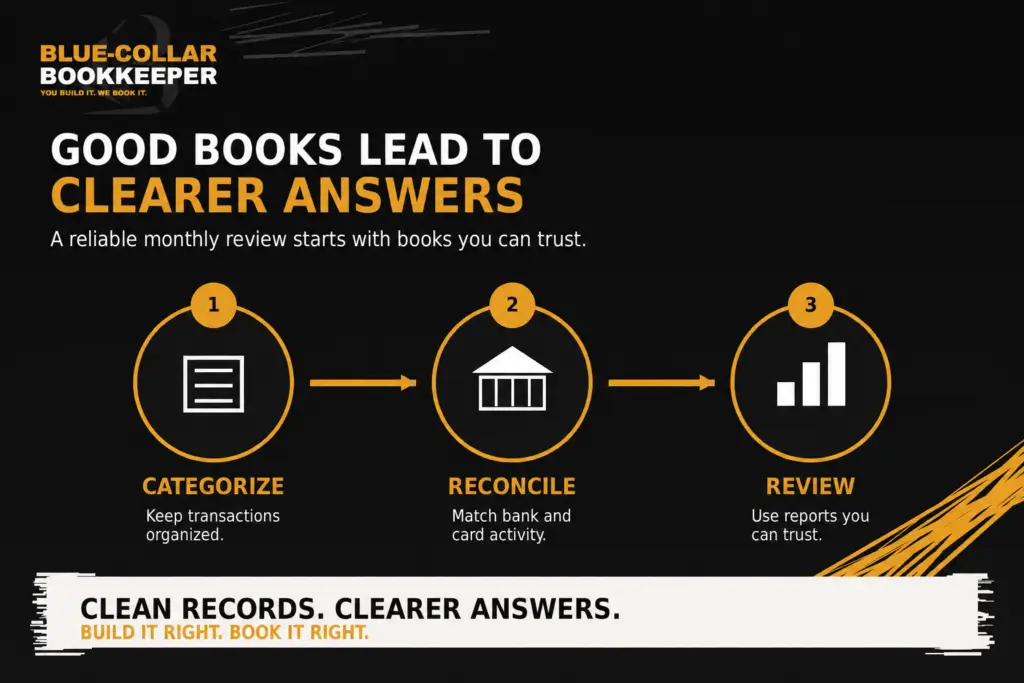
Before you start analyzing reports, the books need to be reasonably current.
If transactions are still uncategorized, bank and credit card accounts haven’t been reconciled, customer payments are missing, or old balances are sitting in the wrong places, the reports may give you the wrong impression.
Reconciliation simply means comparing the activity in your bookkeeping records with the actual bank or credit card account and making sure the two agree.
It isn’t glamorous, but it matters.
If the foundation is unreliable, analyzing the numbers on top of it doesn’t fix the problem.
That’s one reason monthly bookkeeping matters. The ongoing work of categorizing transactions, reconciling accounts, and keeping records current creates the foundation for a useful review.
If your books are already months behind or difficult to trust, you may need cleanup before the monthly review becomes useful.
The goal is simple: review numbers you have a reasonable basis to believe.
The 8 Numbers Worth Reviewing Every Month
You don’t need to study every account in your bookkeeping file each month.
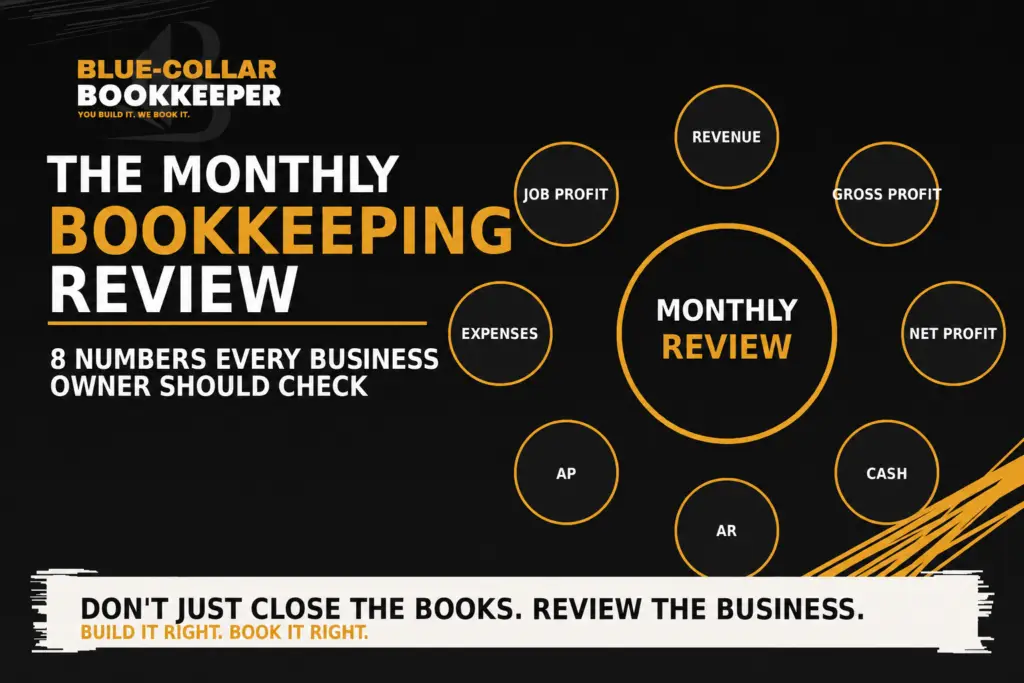
For many small-business owners, these eight areas provide a practical place to start.
The value isn’t in memorizing the numbers.
It’s in understanding what each number is telling you and what question you should ask next.
1. Revenue: What Did the Business Actually Bring In?
Revenue is usually the easiest number to notice.
It’s also one of the easiest numbers to overvalue.
A strong revenue month can feel like proof that the business is doing well, but revenue only tells you the top line. It doesn’t tell you what it cost to produce that revenue or how much of it eventually became profit.
Start by looking at the current month in context.
Was revenue higher or lower than the previous month?
Does seasonality explain part of the change?
Did one unusually large customer or project affect the result?
Is the business becoming more dependent on one type of work?
For a contractor, a big month might come from several projects reaching billing milestones at the same time. For another small business, it might come from one large customer order.
Neither situation is automatically good or bad.
The point is to understand what’s behind the number.
Revenue tells you how much activity reached the top of the financial statement.
The next numbers tell you what happened after that.
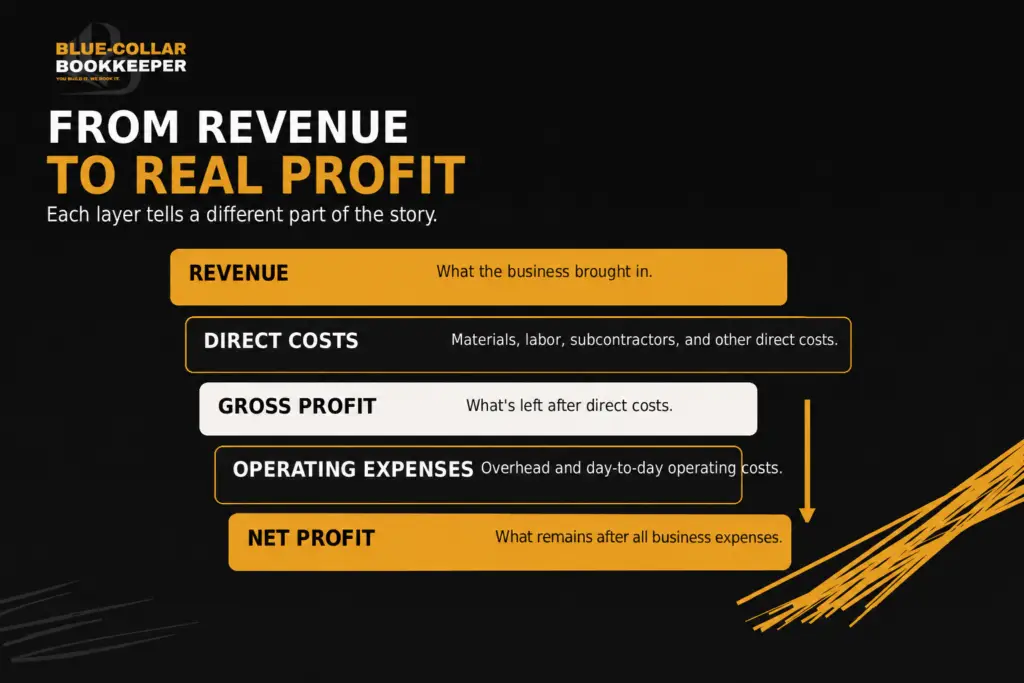
2. Gross Profit and Gross Margin: What Did It Cost to Deliver the Work?
Gross profit is what remains after subtracting the direct costs associated with producing the product or delivering the service.
For a contractor, those direct costs may include materials, field labor, subcontractors, equipment rentals, permits, or other costs connected to the job.
For another type of business, the direct costs may look completely different.
Gross margin expresses gross profit as a percentage of revenue.
You don’t need to obsess over the accounting terminology.
The practical question is:
After paying the costs directly connected to delivering the work, how much was left to help cover the rest of the business?
If revenue rises but gross profit doesn’t rise with it, that’s worth investigating.
Maybe material costs increased.
Maybe labor took longer.
Maybe pricing didn’t keep pace with the cost of delivering the work.
Maybe the mix of products, jobs, or services changed.
Don’t assume a lower or higher gross margin means the same thing for every business. Different industries and business models operate with very different cost structures.
What matters most is understanding your own numbers and watching for meaningful changes.
3. Net Profit: What’s Left After the Business Pays Its Broader Costs?
Net profit goes a step further.
After accounting for the broader expenses of running the business, it shows what’s left for the period according to the accounting records.
That includes costs that aren’t tied directly to one job or sale, such as insurance, software, office expenses, professional services, marketing, and other overhead.
This is one reason revenue can be misleading.
A business can have a strong sales month and still have weak profitability if direct costs or overhead increased at the same time.
Your profit and loss report helps organize that story.
Instead of looking only at whether the bottom line is positive, ask:
What changed from last month?
Which expense categories moved the most?
Was the change expected?
Is it connected to growth, timing, seasonality, or a one-time expense?
Is something becoming a pattern?
One month shouldn’t automatically drive a major decision.
It should give you something to investigate.
4. Cash: How Much Money Is Actually Available?
Profit and cash aren’t the same thing.
That’s one of the most important ideas in a monthly bookkeeping review.
Your profit and loss statement may show a profitable month while the bank account still feels tight.
Why?
Customers may not have paid yet.
You may have purchased materials before receiving the customer’s next payment.
Vendor bills may be due.
Debt payments and owner draws can affect cash.
Money can move differently from the way income and expenses appear on financial reports.
That’s why cash flow deserves its own review.
Don’t stop at today’s bank balance.
Ask what that balance needs to cover.
What’s coming in?
What’s going out?
Which customer payments are still outstanding?
Which bills are about to hit?
A bank balance is useful.
Context makes it useful for decision-making.
5. Accounts Receivable: Who Still Owes You Money?
Revenue doesn’t pay the bills until the money actually gets collected.
Accounts receivable, often shortened to AR, represents money customers still owe the business.
For some businesses, AR is small because customers pay immediately.
For others, especially businesses that invoice customers or bill in stages, receivables can be a major part of cash flow.
A monthly review should help you see:
Which invoices are still open?
Which ones are overdue?
Are balances getting older?
Is one customer responsible for a large portion of what you’re waiting to collect?
Does the bookkeeping agree with what you believe customers actually owe?
Imagine a contractor finishing several jobs during a strong sales month.
The revenue may look encouraging.
But if final invoices and progress payments are still sitting unpaid while material suppliers and subcontractors are expecting payment, the cash picture can feel completely different.
That’s why accounts receivable and accounts payable need to be reviewed alongside revenue and profit.
The point isn’t to panic every time an invoice is open.
It’s to know what’s still outstanding so the business isn’t operating as though billed revenue and collected cash are the same thing.
6. Accounts Payable: What Does the Business Still Owe?
Accounts payable, or AP, is the other side of the timing problem.
It represents bills and obligations the business still needs to pay.
Your bank balance may look comfortable today.
That doesn’t mean all of that cash is truly free for something new.
Vendor invoices may be waiting.
Subcontractor payments may be due.
Equipment, inventory, materials, or other obligations may already be committed.
Reviewing AP helps you understand what’s coming before the money leaves the account.
This is especially useful when AR and AP are reviewed together.
You may discover that customer payments are coming in later than the bills connected to the work.
That doesn’t automatically mean the work is unprofitable.
It may mean the timing of cash coming in and cash going out deserves attention.
The books should help make that timing visible.

7. Operating Expenses and Overhead: What’s Quietly Getting More Expensive?
Not every financial problem arrives as one giant expense.
Sometimes costs creep.
Software subscriptions accumulate.
Insurance changes.
Advertising grows.
Vehicle expenses move.
Administrative costs increase.
Rent, utilities, professional services, and other overhead may slowly take a larger share of the money coming into the business.
That’s why your monthly review should include expense trends, not simply total expenses.
Ask which categories changed.
Then ask why.
Some increases are intentional.
You may have invested in additional staff, better systems, or marketing because the business is growing.
Other increases may be expenses you barely noticed because each one looked small on its own.
The goal isn’t to cut every expense.
It’s to understand what you’re paying for and whether the cost structure of the business is changing.
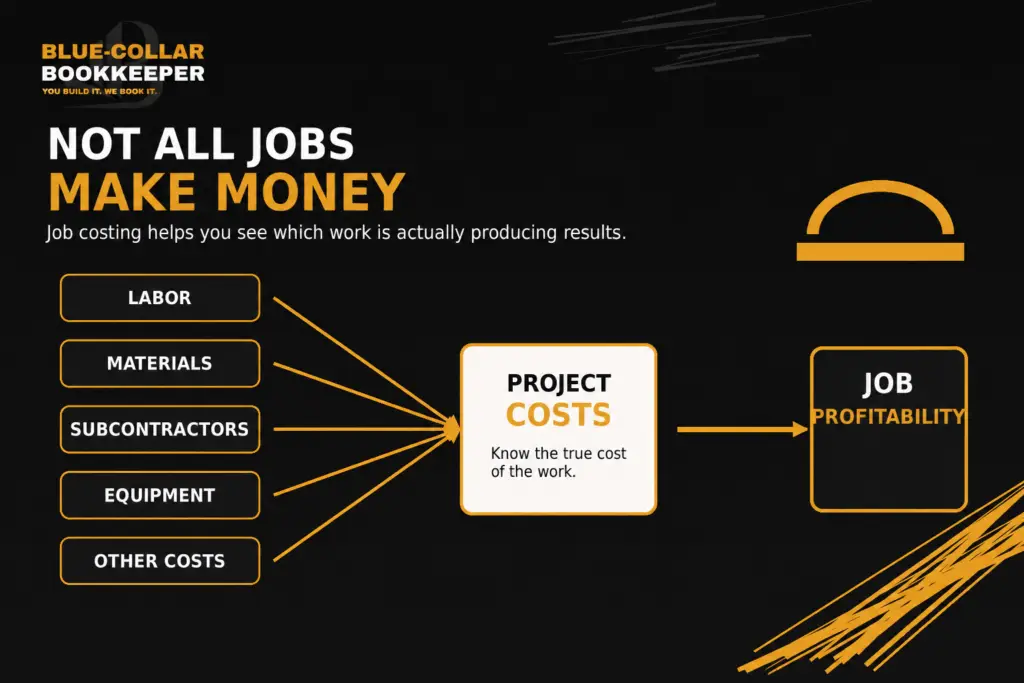
8. Job, Project, or Service-Line Profitability: Which Work Is Actually Producing Results?
Company-wide profit can hide a lot.
Two businesses can show the same overall profit while getting there in completely different ways.
Even inside one company, one type of work may perform very differently from another.
For contractors, job costing and profitability reports can help connect revenue with the materials, labor, subcontractors, equipment, and other costs attached to individual projects.
But the idea isn’t limited to contractors.
A professional-service business may compare different services.
A retailer may compare product categories.
Another small business may compare locations, departments, recurring work, or customer segments when its bookkeeping setup supports that level of detail.
The exact method depends on the business.
The question is the same:
Which work is actually contributing to the business, and which work deserves a closer look?
A busy month doesn’t always mean a productive month.
If certain jobs or services consistently require more time, labor, materials, or support than expected, company-wide totals may hide the problem.
For contractors specifically, reviewing a job profitability report after a project can help connect the monthly numbers to what actually happened in the field.
The Numbers Matter More When You Review Them Together
None of these numbers should live on an island.
Revenue without gross profit can hide expensive work.
Profit without cash can hide collection or timing problems.
Cash without accounts payable can create a false sense of what is available.
Accounts receivable without context can make sales look stronger than collections.
Company-wide profitability without job or service-level visibility can hide which work is carrying the business and which work is draining it.
This is why a monthly financial review works better as a conversation between the numbers.
Suppose sales look strong.
That’s a starting point.
Now look at gross profit.
Then net profit.
Then cash.
Then customer balances.
Then bills coming due.
Then the profitability of the work itself.
The picture gets clearer as the numbers connect.
That’s the difference between reading a report and understanding what the report is trying to tell you.
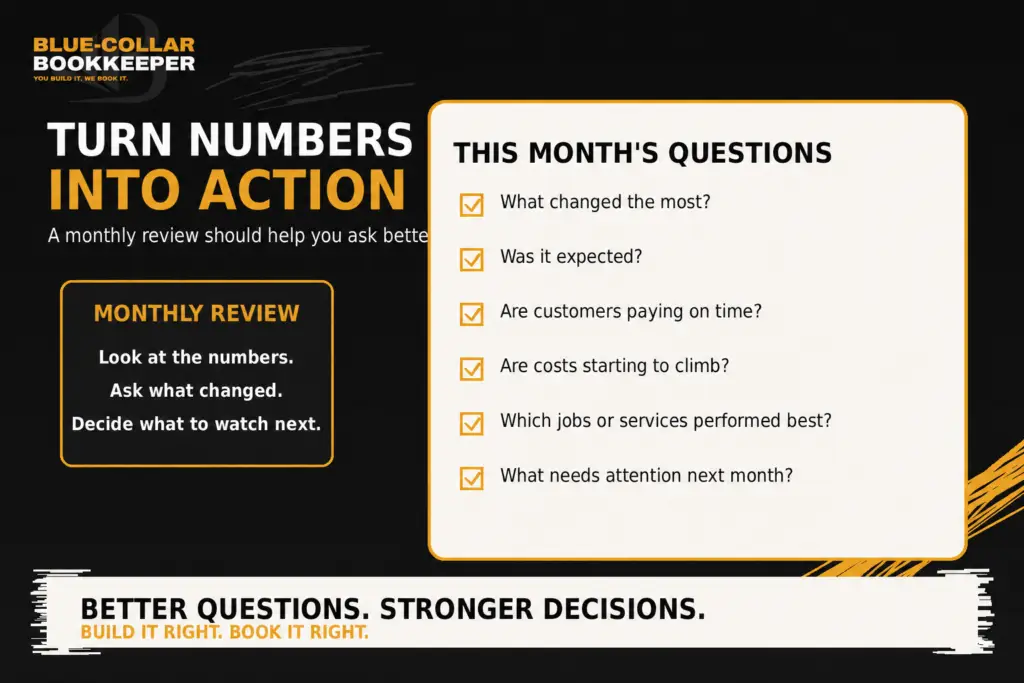
Turn the Review Into Questions, Not Just Reports
Your monthly review doesn’t need to end with a complicated dashboard.
It should end with a short list of questions.
For example:
- What changed the most this month?
- Was that change expected?
- Are customers paying when expected?
- Are bills or operating costs starting to climb?
- Did revenue turn into profit?
- Did profit turn into cash?
- Which jobs, services, or products performed differently than expected?
- Is there anything in the books I don’t understand?
- What should I watch next month?
That’s what useful monthly financial reporting should help you do.
A financial report shouldn’t simply document the past.
It should help you understand what happened well enough to decide what deserves attention next.
When the Reports Don’t Answer the Questions
Sometimes the monthly review exposes a different problem.
You open the reports and realize you don’t trust them.
The bank balance doesn’t match the bookkeeping.
Revenue doesn’t look right.
Old invoices are still open.
Expense categories don’t make sense.
Job costs aren’t being tracked.
Or the reports technically exist, but they don’t answer the questions you actually have about the business.
That’s useful information too.
It may mean the business needs better monthly bookkeeping, cleanup, reporting, AR/AP organization, or job-level tracking before the numbers can become more useful.
You don’t need more reports for the sake of having more reports.
You need books that help you see what’s happening.
Blue-Collar Bookkeeper helps contractors and small-business owners organize their bookkeeping, improve financial visibility, and build a clearer monthly picture of the business.
If your books are making it hard to understand what’s happening, start with a Free Financial Consultation.
We’ll take a look at where your books stand, what may be unclear, and what it would take to get your numbers working for you instead of against you.
Start with a free financial consultation.
You build it. We book it.
Monthly Bookkeeping Review FAQs
What financial reports should a small-business owner review every month?
A practical monthly review often starts with the profit and loss statement, balance sheet, cash position, accounts receivable, accounts payable, expense trends, and any job, project, or service-level reports that are relevant to the business.
The exact reports will depend on how the business operates and how its bookkeeping is set up.
Is profit the same as cash in the bank?
No.
Profit reflects income and expenses according to your accounting records. Cash reflects money currently moving through or available in the business.
A business can show profit while still waiting on customer payments or covering bills and other cash obligations.
How often should I review accounts receivable?
For businesses that invoice customers, receivables may need attention more often than once a month.
The monthly bookkeeping review is a good point to step back and look at the overall pattern, including open invoices and balances that are getting older.
What if my monthly reports don’t make sense?
Start with the underlying books.
Transactions may need to be categorized, accounts may need reconciliation, old balances may need cleanup, or the reporting setup may not match the questions you’re trying to answer.
If you don’t trust the underlying information, fixing that comes before deeper financial analysis.
Do I need job costing if I’m not a contractor?
Not necessarily.
Job costing is especially useful for contractors and project-based businesses, but other companies may benefit from tracking profitability by service, product category, location, department, or another meaningful part of the business.
The right level of detail depends on the business and its bookkeeping system.
Can a bookkeeper help me understand my monthly financial reports?
Yes.
Bookkeeping can help keep the underlying records organized and produce useful reports. Depending on the service provided, a bookkeeper may also help explain what changed and identify questions worth investigating.
Bookkeeping doesn’t replace individualized tax, legal, investment, or financial-planning advice from the appropriate qualified professional.