
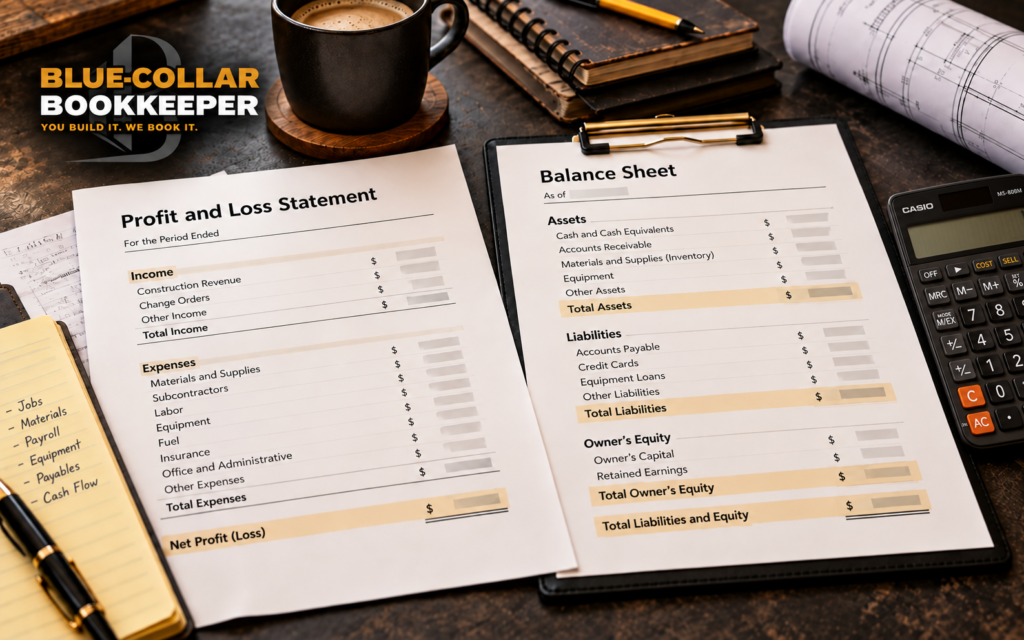
Your profit and loss statement says the company made money.
So why doesn’t the business feel as strong as that number suggests?
Maybe cash is tighter than you expected. Customers still owe you money. Credit-card balances are creeping up. There’s equipment debt sitting in the background. Or you’ve taken money out of the business during a profitable month and can’t quite see where everything stands now.
That doesn’t necessarily mean the P&L is wrong.
It may mean you’re asking one financial report to answer a question it wasn’t designed to answer.
Understanding balance sheet vs profit and loss is important because the two reports look at your business from completely different angles.
Your P&L tells you what happened over a period of time.
Your balance sheet tells you where the business stands at a particular point in time.
Contractors need both.
Your P&L Can Be Profitable While the Business Still Feels Tight
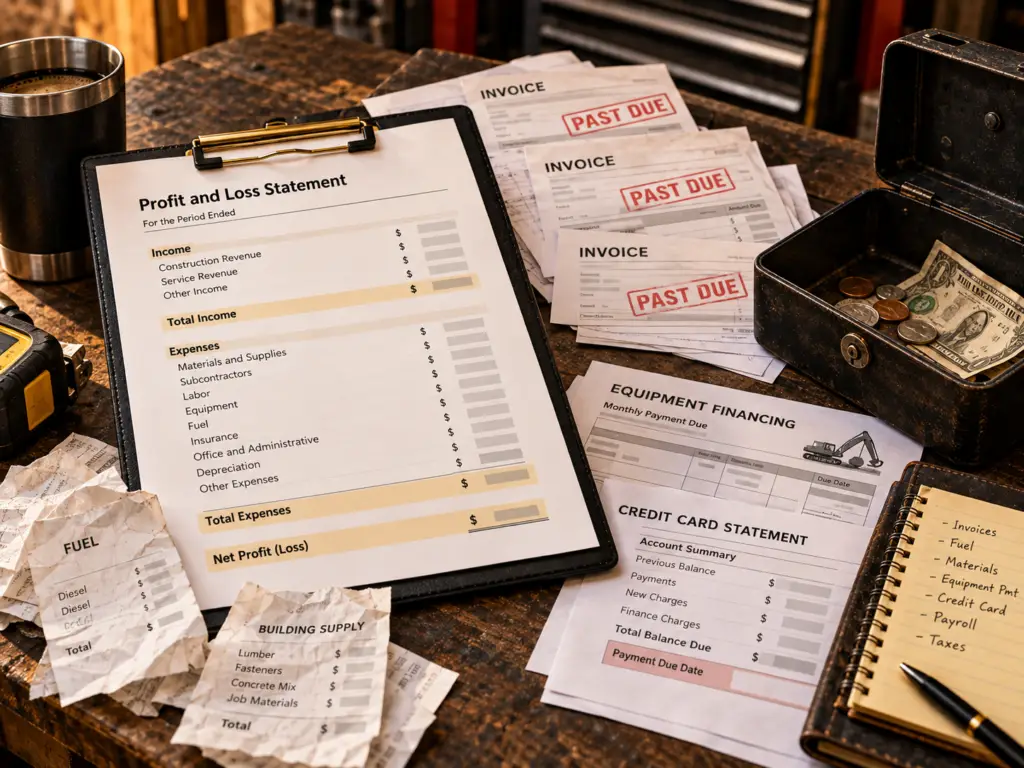
Your profit and loss statement is designed to show income, costs, expenses, and profit or loss over a period.
That makes it valuable.
You can use it to investigate questions such as:
- Is revenue growing?
- Are direct costs increasing?
- Are overhead expenses getting heavier?
- Is the business producing a profit?
- Are margins moving in the wrong direction?
But the P&L doesn’t show every financial obligation or asset your business is carrying.
That’s one reason a profitable month doesn’t automatically mean you have plenty of available cash or that the entire financial position of the company is strong.
If you haven’t already looked closely at how the P&L works, start with Profit & Loss for Contractors: Why Your P&L Doesn’t Always Match Your Bank Account.
The balance sheet takes the next step.
Balance Sheet vs Profit and Loss: The Difference in Plain English
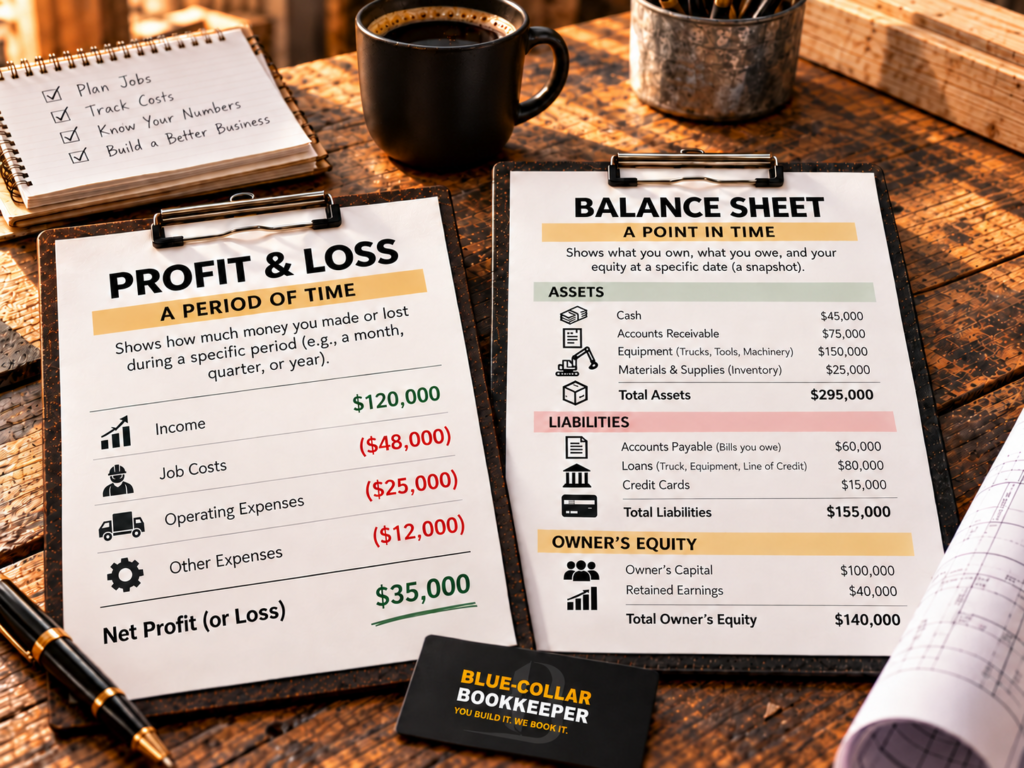
The easiest way to understand the two reports is to think about time.
A P&L covers a period:
- This month
- Last quarter
- Year to date
- Last year
It tells you what happened financially during that period.
A balance sheet is different.
It’s a snapshot of the business on a specific date.
If you run a balance sheet as of September 30, it’s intended to show the financial position of the business at that point.
In basic terms:
Assets = Liabilities + Equity
You don’t need to become an accountant to use that formula.
For an owner, the more useful interpretation is:
What does the business have? What does it owe? What’s left after those obligations are considered?
That’s why your monthly financial reports become more useful when you review them together instead of opening the P&L and ignoring everything else.
What a Contractor Balance Sheet Actually Shows

A balance sheet for contractors uses the same basic structure as other businesses, but the accounts inside it should reflect the way your company actually operates.
Your exact balance sheet may look different depending on your accounting method, entity structure, bookkeeping setup, equipment, debt, billing process, and other factors.
The important part isn’t memorizing every possible account.
It’s understanding the three major sections.
Assets: What the Business Has
Assets are things the business owns or controls that have financial value.
Depending on the company and how the books are maintained, that might include:
- Cash in bank accounts
- Customer receivables
- Equipment
- Vehicles
- Certain deposits
- Other business assets
For a contractor, this section helps answer a question the P&L can’t:
What resources does the company currently have on the books?
A profitable month doesn’t tell you how much cash remains in checking or how much of your revenue may still be waiting to be collected.
Liabilities: What the Business Owes
Liabilities represent obligations.
Depending on the company, these might include:
- Credit-card balances
- Equipment loans
- Vehicle loans
- Lines of credit
- Bills payable
- Other business debt
This is another reason looking only at profit can be misleading.
The P&L may show that operations were profitable during the month while the balance sheet shows the company is still carrying substantial obligations.
That doesn’t automatically mean something is wrong.
It means you need both reports to understand what’s happening.
Equity: What’s Left After Liabilities
Equity is the portion of the business remaining after liabilities are considered.
This is often the least intuitive part of the balance sheet for owners.
Owner contributions, distributions or draws, prior earnings, current earnings, and entity structure can all affect how equity appears.
The important point isn’t to memorize every equity account.
It’s to recognize that taking money out of the business isn’t necessarily the same thing as recording a normal business expense on the P&L.
That distinction can explain some of the situations where profit looks healthy but the cash position changes more than expected.
If something in the equity section doesn’t make sense, that’s a good question to raise with your bookkeeper or qualified accounting professional rather than guessing.
What the Balance Sheet Can Show That Your P&L Doesn’t
This is where the difference becomes useful.
Your P&L may tell you that you had a profitable period.
The balance sheet can help you investigate what happened around that profit.
How Much Cash Is Actually Available
Profit and cash aren’t interchangeable.
You can generate profit and still use cash to:
- Pay down loan principal
- Purchase assets
- Take owner draws or distributions
- Cover obligations from prior periods
Those movements may affect your financial position without appearing on the P&L the same way a normal operating expense would.
How Much Customers Still Owe You
For businesses and accounting setups that track accounts receivable, the balance sheet can show money that customers owe but haven’t paid yet.
That matters because revenue and collected cash don’t always arrive at the same time.
A strong sales month isn’t much comfort when too much money is still sitting outside the bank account.
Accounts receivable deserves its own management process, not just a glance at total revenue.
How Much Debt the Business Is Carrying
Equipment financing, vehicle loans, lines of credit, and credit cards can all affect the financial condition of a contracting business.
A profitable P&L doesn’t tell you the complete story of those balances.
The balance sheet helps you see the obligations that remain after the month is over.
What the Business Owns
Contractors often operate with trucks, tools, machinery, and equipment that may appear on the balance sheet depending on how they’re recorded.
Again, the goal isn’t to become your own accountant.
The goal is to know that those assets are part of the financial picture even though the P&L is focused on activity during the reporting period.
How Owner Activity Is Affecting the Business
Money moving between the business and the owner can change cash and equity without behaving like a normal operating expense.
That’s one reason a business owner can say:
“The P&L says we made money. Where did it go?”
Sometimes the answer requires looking beyond the P&L.
Contractor Balance Sheet Example: A Profitable Month Can Still Reveal Pressure
Imagine a contracting company finishes the month with a profit.
At first glance, that sounds great.
But now look beyond the P&L.
Several large customer invoices remain unpaid. Credit-card balances increased while crews were buying materials. The company still has equipment financing outstanding. The owner also took money out of the company during the month.
None of those facts automatically erase the profit shown on the P&L.
But they change the way you interpret it.
The P&L answers:
Did the company generate a profit from its activity during the period?
The contractor balance sheet helps answer:
What financial position did the company end up in?
That’s the difference.
One report isn’t better than the other.
They’re answering different questions.
Why Your Balance Sheet Might Not Make Sense
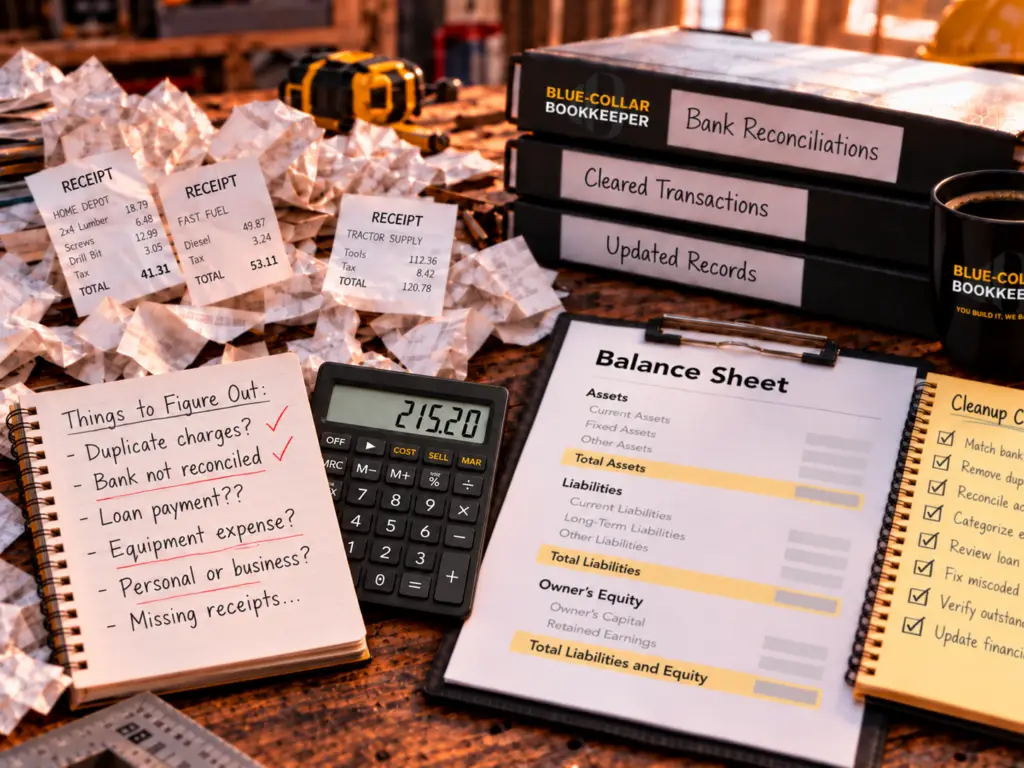
A balance sheet is only as useful as the bookkeeping behind it.
If you open yours and immediately think, “There’s no way that’s right,” don’t just ignore the report.
Investigate it.
Some issues worth reviewing can include:
- Bank or credit-card accounts that haven’t been reconciled
- Duplicate or missing transactions
- Old balances that were never cleaned up
- Loan activity that hasn’t been recorded correctly
- Owner transactions sitting in the wrong accounts
- Strange negative balances
- Receivables or payables that no longer reflect reality
- Assets or liabilities that haven’t been reviewed in a long time
Not every unusual balance represents an error. Some accounts legitimately require accounting treatment that isn’t obvious to a business owner.
But if the report doesn’t resemble the real business, it deserves attention.
That’s one reason cleanup and catch-up bookkeeping matters. Cleaning transactions without reviewing the reports they create can leave the underlying problem hidden.
Ongoing monthly bookkeeping also gives you a better opportunity to catch questionable balances before they sit unnoticed for months or years.
How Contractors Should Review the P&L and Balance Sheet Together
You don’t need to spend hours analyzing financial statements every month.
But you should be able to open your reports and ask useful questions.
Start with the P&L.
Ask:
Did we make money?
Then look deeper.
Which revenue changed? Which direct costs changed? Did overhead move? Did gross profit or net profit look different than expected?
Next, open the balance sheet.
Ask:
Where do we stand now?
Look at cash.
Look at amounts customers still owe where applicable.
Look at credit cards and debt.
Look at unusual balances.
Look at owner activity.
Then connect those reports to what’s happening in the field.
If company-wide profit looks acceptable but certain projects keep disappointing you, that’s where job costing and profitability reporting becomes important.
The reports work together:
P&L: Are we profitable?
Balance sheet: What financial position are we in?
Job profitability: Which jobs are creating the results?
Once you can answer all three, your bookkeeping starts becoming a management tool instead of a stack of reports you receive after the month is already over.
Frequently Asked Questions
What is the main difference between a balance sheet and profit and loss statement?
A profit and loss statement shows income, costs, expenses, and profit or loss over a period of time.
A balance sheet shows assets, liabilities, and equity at a specific point in time.
Which is more important, the balance sheet or P&L?
Neither report replaces the other.
The P&L helps you understand operating performance and profitability. The balance sheet helps you understand financial position.
Contractors generally get a better picture of the business when they review both.
Why does my P&L show a profit when my bank balance is low?
Profit and cash are different.
Cash may have been used for loan principal, asset purchases, owner withdrawals, obligations from previous periods, or other transactions that don’t affect the P&L in the same way as a normal operating expense.
Customer-payment timing can also matter.
What should contractors look for on a balance sheet?
Start with the areas you understand in the real business:
- Cash balances
- Customer receivables where applicable
- Credit cards
- Loans and other debt
- Major assets
- Owner equity activity
- Any balance that looks strange or outdated
If the numbers don’t resemble what you know is happening in the business, investigate before relying on the report.
How often should a contractor review the balance sheet?
For businesses receiving monthly financial reports, reviewing the balance sheet alongside the P&L each month can help identify changes and questionable balances earlier.
The appropriate reporting frequency can vary depending on the size and complexity of the business.
Your Reports Should Help You Run the Business
Financial statements aren’t useful just because your bookkeeping software can generate them.
They’re useful when they help you understand what’s happening.
Your P&L can show whether the business generated a profit.
Your balance sheet can help show what the company owns, what it owes, and where the business stands after all that activity.
And when those reports are clean and reviewed together, you can start asking better questions before small financial issues become big surprises.
Blue-Collar Bookkeeper’s Monthly Financial Reporting service is designed to help business owners get clearer financial information from their books, not just another report to file away.